Skip navigation

Proposed activities

Activity 1. Charged bodies

Draw:

a) an atom that has 4 protons and a net charge of +2

b) an atom with 10 electrons and a net charge of -1

c) a neutral atom with 5 protons

SOLUTION:

a) + + + + - -

b) + + + + + + + + + - - - - - - - - - -

c) + + + + + - - - - -
Activity 2. Coulomb´s law

The force between two charged bodies is, space,  to their charges and, space,  to the square of the distance between them.

This means that the greater the charges, the, space,  the force, while the greater the distance, the, space,  the force.

It also means that in the expression to calculate the force the charges will appear in the, space,  and the square of the distance in the, space,  .

If the charges are of the same sign, the force will be of, space,  and if they are of opposite sign it will be of, space,  .

Enable JavaScript

Activity 3. Coulomb's law calculations

Calculate the value of the force between two charges of 4 μC in vacuum, if the distance between them is 2 m.

Audio: 

Answer: F =

Enable JavaScript

Activity 4. Classify as conductors or insulators

Classify these object as conductors or insulators:

Plastic pen: 

rubber: 

wooden ruler: 

tin can: 

gold necklace: 

towel: 

aluminum foil: 

paper sheet: 

key: 

coin: 

glass bottle: 


Enable JavaScript

Activity 5. Conductors and insulators

Indicate what type of material (conductor or insulator) would be adequate to build the following objects:

electric cable (inside):

electric cable (outside):

switch button: 

light bulb base:

bulb of a light bulb: 

the part of the power plug that is inserted into the socket:

socket cover: 

Electrical pliers handle: 

electrician's shoes sole: 

Enable JavaScript

Activity 6: Circuit receivers function

Choose the circuit element that converts electrical energy into:

light:

movement:

heat:

sound:

Enable JavaScript

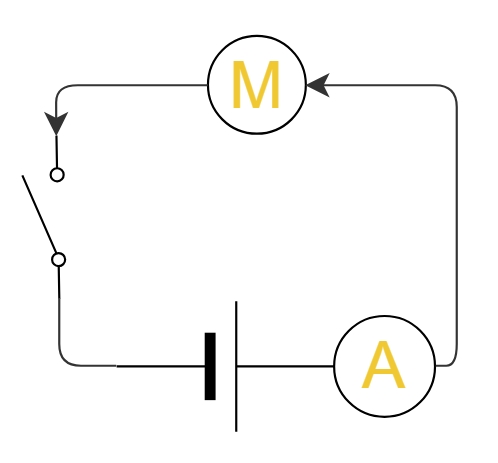
Activity 7. Draw a circuit

a) Read these instructions to a class mate:

"Draw a circuit diagram containing a battery, a motor, an ammeter and a switch"

If there is any symbol that she/he can not remember, describe it for her/him.

Solution:

b) Now he/she has to invent a similar statement with the elements he/she choses for you to draw. And you can receive clues as well if there is a symbol that you don´t remember.

Repeat the exercise one more time each of you, changing the elements.

Activity 8. Electrical magnitudes

Read the paragraph below and complete the missing words.

The energy supplied by the generator per unit charge is called, space . It is measured in, space,  .

The energy per unit, space, charge between two points in a circuit is called potential difference, space,  or tension, and is measured in volts. The instrument used to measure it is the, space, .

Current intensity is the amount of electric, space, that passes through a section of material per unit, space, . It is measured in, space, and its measuring instrument is the, space, .

space, measures the opposition that a material presents to the flow of electric current. It is measured in, space, .

Enable JavaScript

Activity 9. Memorize electrical magnitudes definition

Now try to do the exercise in reverse. Define electromotive force, voltage, intensity and resistance orally, and check, by looking at the solution, that you are able to construct a definition that contains the key words. Record the definitions with your mobile phone. Recording what you want to learn and listen to it while you are walking, cleaning, resting,... is a good trick for memorisation!

Activity 10. Ohm´s law problems

Do the problems in your notebook and write the result.

1. Calculate the resistance of a circuit with a 12 V battery through which a current of 20 A passes.

=  Ω

2. Calculate the potential difference on both sides of a 4 Ω resistor if the current passing through it is 2 A.

=

3. What value would an ammeter in a circuit containing a 3 Ω resistor connected to a 4.5 V battery indicate?

=

Enable JavaScript

Actividad 11. Variables that influence resistance

Calculate the cross-section of a copper cable (resistivity=1.7 10-8  Ω m) knowing that the resistance of 20 m of cable is 0.34 Ω. Express it in mm and without decimals (round to the nearest units).

A = mm 2

Enable JavaScript

Actividad 12. Calculate resistance

Calculate the resistance of a steel cable 1 km long, with a circular section of radius 2 cm.

Steel resistivity = 7.2 ·10 -7  Ω·m

Write the answer with two decimal digits and a point: R =  Ω

Enable JavaScript

Activity 13. Series circuits

a) Calculate the equivalent resistance of a series circuit with two light bulbs of resistances 1 and 1.25 Ω .

b) Calculate the current that passes through them when they are connected to a 4.5 V battery .

a) R =  Ω

b) I =

Enable JavaScript

Activity 14. Draw a parallel circuit

Draw a circuit diagram with a battery, a push button and a light bulb in parallel with a bell. Add a voltmeter to measure the potential difference between the ends of the bulb.

SOLUTION:

Activity 15. Parallel circuits

a) Calculate the equivalent resistance of a parallel circuit with two 6 Ω resistors .

b) Calculate the intensity that would pass through the circuit battery if it supplies a voltage of 9 V.

c) Calculate the intensity that would pass through each of the resistors .

a) R =   Ω

b) I =

c) I1 = I2 = =

Enable JavaScript

Activity 16. Think and explain

Talk to your class mate and discuss why the lamps of this circuit bright with different intensity. Afterwards, try to prove your point mathematically.

SOLUTION:

It is a parallel circuit. The higher the resistance in a branch, the less current will circulate through it:

I 1 = V/R 1 = 9/1000 = 0.009 A

I 2 = V/R 2 = 9 /200 = 0.045 A

I 3 = V/R 3 = 9/10 = 0.9 A

Activity 17. Crossword Review


Click "retry" to start

Creado con eXeLearning (Ventana nueva)