6.1. What does the electrical resistance depend on?
Investigation activity. Video (1 min) with exercises
This time, you will be the scientist who investigates which variables influence resistance. In the following video, your assistant will make some changes in a cable to see what effect they have on resistance. As a good scientist, he/she will change only one characteristic of the cable at a time, leaving the others constant.
There are three characteristics of the wire that you could change. One is the type of material it is made of. The quantity we use to indicate how difficult it is for electric current to flow through a certain type of material is resistivity, which is symbolized by the Greek letter ρ (read "rho").
What other two cable characteristics do you think you could change? Think about it before you hit play. You'll find the answer in the video.
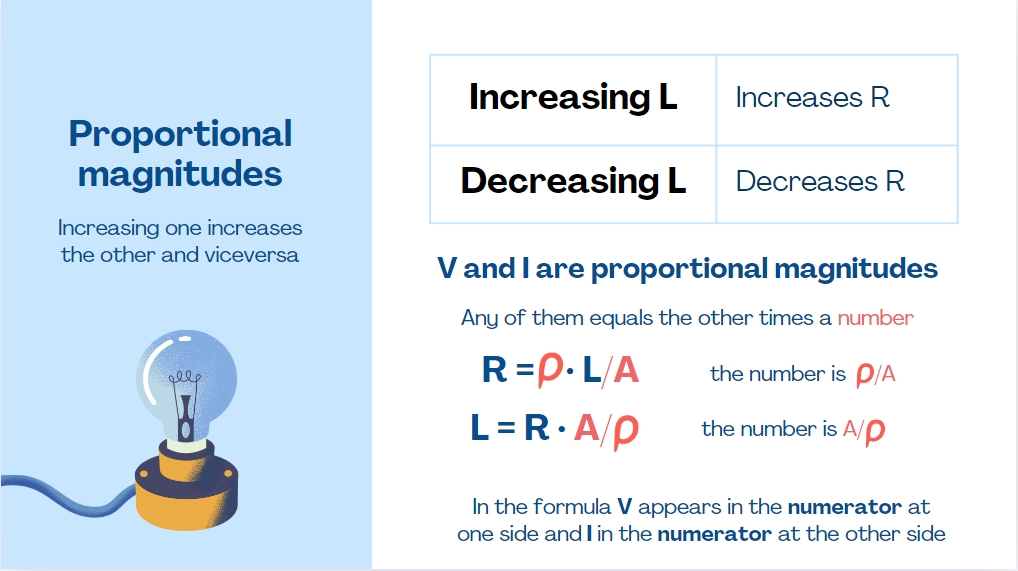
What happens if you increase the length of the wire? The resistance increases because the electrons have to travel a greater distance, and therefore they will lose more energy colliding with the atoms that make up the wire on their way. We say that resistance and length are directly proportional magnitudes, since when one increases, the other increases proportionally. What happens if you increase the area or section of the wire? The resistance decreases because the electrons have a larger gap to pass through, and they will find less opposition to pass through there. Area and resistance are inversely proportional magnitudes, because when one increases, the other decreases proportionally.
What happens if the wire material has a higher resistivity? The resistance increases. Resistivity and resistance are directly proportional.
After having analyzed the results that your assistant has provided you, it is time to draw conclusions and write them down in the universal language of mathematics. Do you dare to propose a formula?: R = ro ρ · timesL / divided by A
Factors that affect the value of a wire resistance
Since resistance is proportional to resistivity and length and inversely proportional to the area of the wire, we can write that R will be equal to the product of the first two magnitudes divided by the second: R = ρ · L / A
Comprenhension exercise. Choose the correct answer
Look at the following image and, after reading the data of the problem, choose the correct option in each question:
a) El cable A tiene mayor resistencia que el B porque su sección es menor
b) El cable A tiene mayor resistencia que el C porque su resistividad es mayor
c) El cable C tiene mayor resistencia que el D porque su longitud es mayor
Step by step problem resolution. Fill in the gaps
Completa los huecos:
Calculate the resistance of a copper cable 40 cm long and 2 mm2 in section . Copper resistivity = 1.72 10-8 Ω m
Step 1. Write the data:
ρ = 1.72 · 10 -8 Ω·m
L = 40 cm
A = 2 mm2
Step 2. Express the data in SI units: Write the numbers in decimal notation and using a comma.
L = 0.4 m
A = 0.0002 m 2
Step 3. Write the formula:
R = ρ · L / A
Step 4. Substitute the data, calculate and express the result with a significant figure and in the appropriate units:
R = 1.72 · 10 -8 · 0.4 / 0.0002 = 0.00003 Ω
Audio of the problem:
Audio with solutions:
Autonomy and calculation exercise. Fill in the gaps
Calculate the resistance of a silver wire 2 m long, 1.5 mm2 cross section and resistivity of 1.59 10-8 Ω m. Solve the exercise step by step in your notebook and write the result in decimal notation with a significant figure and comma.
Audio with the problem statement:
L = 2 m
S = 1.5 mm 2 = 0.0000015 m 2
ρ = 1.59 · 10 -8 Ω·m
R = ρ · L / A = 1.59 · 10 -8 · 2 / 0.0000015 = 0.02 Ω