Skip navigation

4. The electric current

When charge can move

In materials where electrons can move freely (such as metals) we can make them flow, creating an electric current. To make the electrons move we must provide them with the necessary energy, using devices such as batteries, and a closed circuit made of metal wire. We use electric currents to control and operate devices such as phones, computers, household appliances, light bulbs...

An electric current is a flow of charge.

Power cable from Vectorportal.com CC-BY 

            Power line from  Pxhere.com CC 0
  Electrical circuit made with CANVA CC0                                 


Alternating current and direct current


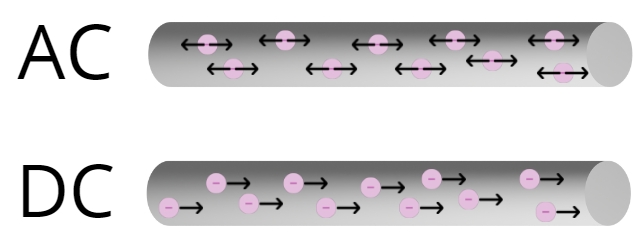
AC and DC, Ana Dapena Mora, created with CANVA, Licensed by CANVA .

Electricity can move in a circuit in two different ways:

  • Direct current (DC) – electrons (pink dots in the figure) always flow in the same direction. Most small battery-operated toys and devices have circuits that work this way.
  • Alternating current (AC) – electrons constantly change direction, many times per second. Appliances that we plug into the sockets, such as household appliances, use alternating current (AC).
    For example, in a light bulb that runs on direct current, new electrons would constantly enter the filament, providing it with energy that will be converted into light. With alternating current, the same electrons are constantly moving back and forth in the filament.

The rock group AC/DC took its name from the abbreviation of these types of current.


Conductive and isolating materials

CONDUCTORS

Materials that allow electric current to pass through them easily

The best conductors are metals, because they are made up of metallic elements, which tend to lose electrons to acquire a noble gas configuration. These electrons that are released can move.

INSULATORS

Materials that do not conduct electricity 

The atoms that form insulators tend to have electrons held in bonds (as in the case of covalent bonds). These electrons cannot move. Wood, plastic, ceramics, glass... are good insulators.

Image audio:  

Comprenhension exercise. Clasify

Classify the following materials as conductor or isolators. Remember that a conductive material is one made up of metallic elements, which are characterized by:

  • In the periodic table they are on the left
  • They are solid at room temperature, hard and have a metallic luster.

 copper 

 cotton 

 plastic

 silver  

 air

 aluminum  

 wood

 rubber 

Enable JavaScript


Creado con eXeLearning (Ventana nueva)