The stave II
LIVE MUSIC 3: The stave II
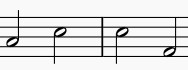
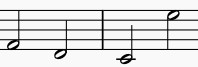
IntervalsAn interval is the diference in distance between two notes with different pitches. There are some types of intervals: a) Melodic or harmonic: The notes sound successively in melodic intervals, in harmonic intervals, the notes sound simultaneously. b) Ascending or descending: If it is an ascending interval, the note with a lower pitch precedes the one with the higher pitch. If it is descending, the note with the higher pitch precedes the one with the lower pitch. c) Simple or compound: Simple intervals are no longer than an octave (octaves, fifths, thirds, etc). Compound intervals are larger than an octave (ninths, tenths, elevenths, etc.) d) Conjunct or disjunct: In conjunct intervals the notes rise or fall with only one pitch change. In disjunct intervals melody moves by intervals longer than a second. A perfect unison is an interval of two notes with the same pitch.
MelodyMelody is the sequence of notes played one after another and arranged in a definite pattern of pitch and rhythm to produce a tune.As the melody progresses, the notes create a visible shape or contour on the score. Depending on that shape, melodies can be ascending (rising shape), descending (falling shape), undulating (rising and falling in similar intervals), static (contour doesn't move too far up or down) and zigzag (rising and falling leaps are arranged in irregular size peaks).
HarmonyHarmony is the combination of two or more notes played simultaneously to produce a sound. While melody was represented horizontally, harmony is represented vertically. There are two types of harmony: a) Consonant: The notes combine to produce smooth blending sounds which convey the idea of pleasantness and sweetness. b) Dissonant: The notes combine to produce sounds which are discordant and provoke a feeling of conflict, tension or sense of motion.
Beat
TempoTempo refers to the speed of a piece of music. It is indicated at the beginning of the score with symbols that refer to Italian words and it is measured in beats per minute (bpm). In modern scores, tempo may be indicated by means of the bpm indication. Sometimes both markings are possible. .
. DynamicsDynamics refers to how loud or quiet a melody has to be played, that is, it deals with volume. As we studied in unit 1, there are some Italian terms and their corresponding abbreviations to indicate dynamic and also some symbols.   Meter/ Accent/ RhythmMeter refers to the organization of accented and unaccented beats in bars to form a regular pattern. This pattern is indicated by the time signature. Accent (also called stress) is the emphasis on a particular note to set it apart from the rest of notes. The accent usually occurs on the first beat of every measure or bar. If there are two beats in a bar, it is called duple meter, if there are three, it is a triple meter and if there are four, it is called a quadruple meter.
Rhythm is the pattern created by the combination of sound, silences, accented and unaccented beats in time.
PhraseA phrase is a section of a composition that has a complete musical sense. It is similar to sentences in a paragraph. There are several ways to identify phrases: a phrase may finish at the end of a slur or tie; phrases usually finish after four bars but they can be any length; if you sing the melody, the phrase usually ends when you need to breath; if there are lyrics, the end of the phrase may happen at the same time as colons or stops. The end of a phrase is called cadence (a melodic, harmonic or rhythmic change). Cadences may be perfect, if the melody sounds as it was finished, or imperfect, if it sounds as there is an unsolved melody. Perfect cadence Imperfect cadence FormForm is the way a melodic composition is organized. The different parts are named A, B, C, etc. and they may be combined in different ways: -Strophic form: The same passage or verse is repeated over and over again. It is typical of children's songs or some traditional melodies: Al citrón, Mary had a little lamb, Amazing Grace , etc. -Binary form: The melody has two sections, A and B. If the parts are repeated they can be: AA BB. Some examples are: Greensleves, Water Music by Handel. -Ternary form: It consists of three parts. The first and second usually show a contrast, while the third one may be equal (A B A) or similar to the first one (A B A'): Twinkle, twinkle little star, Over the rainbow. -Rondo form: It has a section, called episode, which is repeated and alternates with contrasting sections (A B A C A D A). Beethoven's String Quartet, Indiana Jones films soundtrack. Pop songs can be divided into different parts: -Introduction: It attracts the listener's attention and usually indicates the type of song we are going to listen to (sad, happy, etc.). It is placed at the beginning. -Verse: It tells the main story of the song. -Bridge: It is a part that serves as a connection between the verse and the chorus. -Chorus: It is the part that is repeated all through the song after a new verse. It is usually the easiest part to remember. -Solo: It is usual in jazz and rock. Only one instrument plays a melody in the middle of the song or towards the end. -Interlude: It is any part played by some instruments at the same time. -Coda: It is the last part that is used to close the song. |
|||||||||||||||||||||||||||||||||||||




LIVE MUSIC 3: Reading scores
Here you have more symbols you need to know to read music properly. You must study them.
 F-clef (or bass clef) is mainly used for low sounding instruments and notes. F-clef (or bass clef) is mainly used for low sounding instruments and notes.  |
 A tie is a symbol that connects the head of two notes of the same pitch to indicate that these two notes will be played as one. The total value will be the sum of the two notes. A tie is a symbol that connects the head of two notes of the same pitch to indicate that these two notes will be played as one. The total value will be the sum of the two notes. |
 This symbol indicates that the last bar should be repeated. This symbol indicates that the last bar should be repeated. |
 A dotted note has a small dot on the right. It increases the note's duration by half. It can be used with rests. A dotted note has a small dot on the right. It increases the note's duration by half. It can be used with rests. |
 |
 F-clef notes F-clef notes |
 A fermata indicates that the note can be held longer than its value according to the player or conductor's decision. A fermata indicates that the note can be held longer than its value according to the player or conductor's decision. |
 A slur is a line that joins two notes with different pitches and indicates that the notes in between should be played smoothly and with no space between them. A slur is a line that joins two notes with different pitches and indicates that the notes in between should be played smoothly and with no space between them. |
 That letter stands for common time, another way to indicate 4/4 time. That letter stands for common time, another way to indicate 4/4 time. |

Flat note: The symbol indicates the note has to be played one semitone below its natural sound. |
 Sharp note: It indicates the note placed after it has to be played a semitone higher than its natural state. Sharp note: It indicates the note placed after it has to be played a semitone higher than its natural state. |
 Natural: This symbol indicates that a note has stopped being flat or sharp to recover its natural sound. Natural: This symbol indicates that a note has stopped being flat or sharp to recover its natural sound. |
 The letter C with a vertical line stands for cut time, another way to indicate 2/2 time. The letter C with a vertical line stands for cut time, another way to indicate 2/2 time. |
Licensed under the Creative Commons Attribution Non-commercial Share Alike License 4.0