Minerals
Minerals
| The different layers of the Earth are made up of minerals and rocks. Minerals are materials that happen naturally. They have a fixed chemical formula and an orderly crystalline structure. | |||
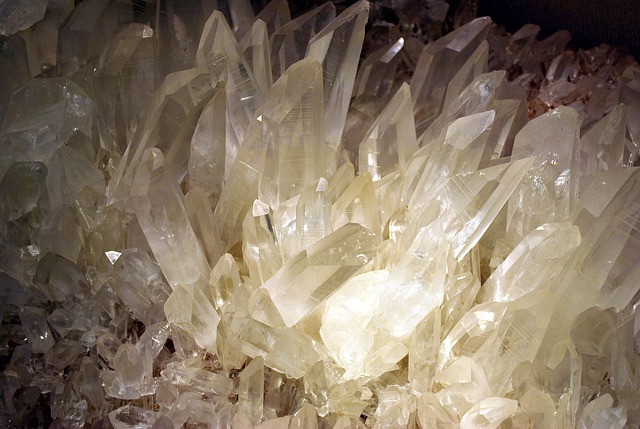 |
USGOV.jpg "Feldspar") |
 |
 |
| QUARTZ | FELDSPAR | GYPSUM | TALC |
 |
 |
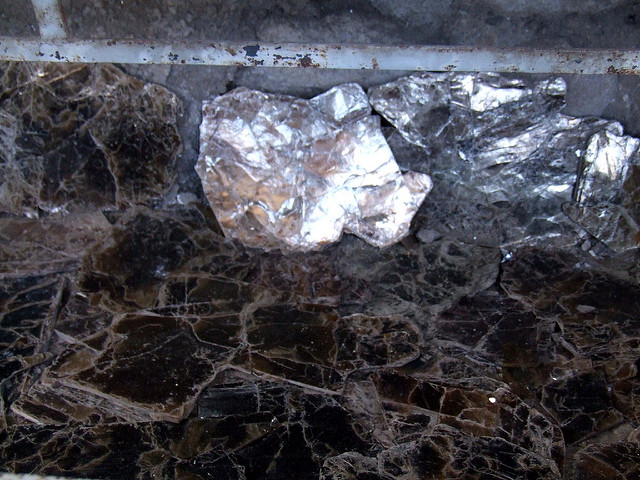 |
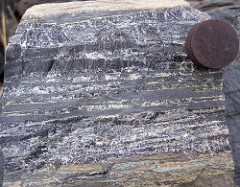 |
| ORTHOCLASE | CORUNDUM | MICA | MAGNETITE |
Properties of minerals
| Minerals are classified depending on their composition but there are some properties that may be useful to identify minerals. Some are: colour, streak, lustre, crystal habit, hardness, cleavage, tenacity and magnetism. | |||
 Scratch test. Jimmie. Flickr. (CC-BY) Scratch test. Jimmie. Flickr. (CC-BY) |
STREAK: It is the colour of the powder remaining when a mineral is scratched. | LUSTRE: It is the description of how light reacts on the surface of the mineral, for example, transparent, metallic, pearly... | CRYSTAL HABIT: It refers to the general external shape of a mineral, for example, cubic, octahedral... |
| HARDNESS: It is the resistance of a mineral to be scratched by another mineral. | CLEAVAGE: It is the way a mineral breaks through its weaker part. | TENACITY: It is the reaction of a mineral to situations such as breaking or bending. Different forms of tenacity are: malleability, flexibility, ductility, frailty, etc. | MAGNETISM: It is the power of a mineral to attract or push away iron or steel elements. |
Activity 1 and 2
Activity 3
Activity 4
Extra activities

Red topaz crystal taken at the National History Museum, London .Aram Dulyam. Wikimedia. (Public Domain)
|
1. Listen to some words used to talk about the properties of minerals. Search the Internet to find out what they refer to. Pearly
Ductility
Malleability
Failtry
Octahedral
|
||||||||
|
1. Siderite is attracted by magnetite. 2. Quartz, orthoclase and calcite are silicate minerals. 3. Diamonds are made up of carbon. 4. Gypsum has a salty taste. 5. Ruby and sapphire are varieties of corundum. 6. Topaz and olivine show an orthorhombic crystal system. 7. Quartz is harder than topaz. |
|||||||||


Projects
| MINERAL FAIR | ||
| Group A | Group B | Group c |
| Have a look at this link. You can see Mohn's hardness list. Create a poster to show the rest of students which minerals are in the list and why they are in the list. If possible use photos of the minerals and explain who Mohs was. |
Create a fact file sheet including a photo of the minerals and the properties you have seen in this unit. Use the minerals in the first exercise of this unit and add other common minerals in Galicia. If it is possible show real minerals too. |
Organize the information from the other groups so that all students in the school can see it properly. Group a: Make a poster with the use of minerals in our daily life. Group b: Make a poster informing how to handle minerals safely. |
| When the posters and fact sheets and real minerals are ready, group 3 member will organize the information. Students should be able to explain other students visiting the Mineral Fair the aspects they have worked on. | ||
Licensed under the Creative Commons Attribution Non-commercial Share Alike License 4.0