Skip navigation

Layers of the Earth

Layers of the Earth

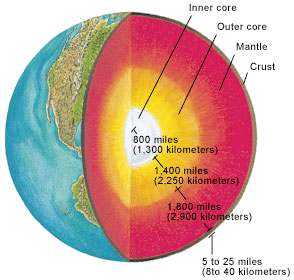
Earth Layers

      Earth layers. NASA. Wikipedia. (Public Domain)

The Geosphere is the solid part of the Earth consisting of several layers: crust, mantle, outer core and inner core.

Crust: It is the outermost layer of the Earth. It's made of solid rocks, mainly granite and basalt, and minerals. It is 40 km deep and it is divided into oceanic crust and continental crust.

Mantle: It is the second layer of the Earth. It is about 2,900 km deep and has two parts:

 - the upper mantle, which contains solid and molten rocks.

 - the lower mantle, which mainly contains solid materials.

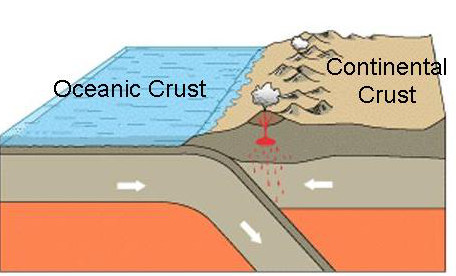
Continental and oceanic crust

     Oceanic-Continental convergence. William Crochot. Wikipedia. (Public Domain)

Outer core: It is such a hot layer that metal and rocks get melted so it is a molten layer. It contains mainly iron but also nickel, oxygen and sulfur. It is about 2,400 km deep. Inner core: It is the hottest layer and the centre of the Earth. It is solid because there is a lot of pressure in it. It is mainly made up of an iron-nickel alloy but there are also other metals. It is about 1,200 km deep.

Activity 1

1. Listen and mark with an X the definition of the word that corresponds to the sound.
a. Inner core b. Crust c. Mantle
a. Outer core b. Mantle c. Inner core
a. Mantle b. Inner Core c. Crust
a. Crust b. Inner Core c. Mantle

Enable JavaScript

Activity 2

2. Listen and choose the missing word.
Crust: It is the outermost layer of the Earth. It's made of rocks, mainly granite and basalt, and minerals. It is 40 km deep and it is divided into crust and crust.

Mantle: It is the layer of the Earth. It is about 2,900 km deep and has two parts:

 - the mantle, which contains solid and molten rocks.

 - the mantle, which mainly contains solid materials.

Outer core: It is such a hot layer that metal and rocks get melted so it is a layer. It contains mainly but also nickel, oxygen and sulfur. It is about 2,400 km deep. Inner core: It is the hottest layer and the of the Earth. It is solid because there is a lot of in it. It is mainly made up of an iron-nickel alloy but there are also other metals, It is about 1,200 km deep.

Enable JavaScript

Activity 3

3. Mark with an X the right answer for the questions.
1. Which of these is the hottest ? a. Inner core b. Outer core
c. Mantle
2. Which one is made up of molten materials? a. Inner core b. Crust
c. Outer core
3. Which layer is above the mantle? a. Inner core
b. Outer Core c. Crust
4. Which is the widest layer? a. Crust b. Inner Core c. Mantle
5. Which layer stands the highest pressure? a. Crust b. Core c. Mantle
6. Which layer is made up of some minerals and an iron-nickel alloy? a. Inner Core b. Crust c. Mantle

Enable JavaScript

Extra activity

TeamworkWatch this video and in pairs decide if the following sentences are true (T) or false (F). You'll have to explain your answers aloud for the rest of the class.

The Interior of the Earth. Abby Christiansen. YouTube. (CC0)

1. There are two ways to classify the layers of the Earth.
2. We can find silicates in the crust.
3. The iron in the core gives the Earth its magnetic properties.
4. The Lithosphere is the rocky part in the crust.
5. Tectonic plates are driven by the Asthenosphere.
6. The lava helps us to know what materials there are inside the Earth.

Enable JavaScript

Inge Lehmann


Inge Lehmann was a Danish seismologist who studied the inner core of the Earth.

Inge Lehmann. Thế Giới Đồ Chơi. YouTube. (YouTube Standard Licence)

She was born in 1888 and grew up in Copenhagen where she attended a high school that treated boys and girls equally. Then she studied mathematics at the University of Copenhagen, where she graduated in 1920. Later she studied seismology and became the Head of the Seismological Institute. In 1936 she cofounded the Danish Geophysical Society and chaired it in 1942 and 1944.

Inge Lehmann made important discoveries about how seismic waves moved at different velocities through the different layers of the Earth after an earthquake. She also discovered an area between the inner and outer core where the seismic waves moved faster. It was called the Lehmann's discontinuity.

Her discoveries were so important that she received the Medal of the American Geophysical Union in 1971 and the Medal of the Seismological Society of America in 1977.

Read the text and mark with an X the right option.
1. Inge Lehmann was from... Danish Denmark
2. She was born in the... 19th century 20th century
3.She received the same education as a boy when she was at high school. True False
4. She only studied seismology. True False
5. She graduated from University when she was... 32 30
6. She discovered an area between the inner and outer core where the seismic waves moved... at a higher speed really slowly
7. She received the Medal of the American Geophysical Union in...
1977 1971

Enable JavaScript