HISTORY
Musical Nationalism
Do you remember that during the Baroque period the most important country was Italy? And during the Classicism and Romanticism? Vienna. So, although composers were from different countries, the compositions were very similar.
But there were some composers who got tired of doing always the same and looked for inspiration in the melodies and songs of their own countries of origin. That’s how Nationalism emerged.
Some of these composers were:
 M. Mussorsgky (Russia): Pictures at an Exhibition
A. Dvorak (Czech Republic): New World Symphony
 E. Grieg (Norway): Peer Gynt
J. Sibelius (Finland): Finland
B. Bartok (Hungary): Mikrokosmos
Z. Kodaly (Hungary): Hàry Jànos
Manuel de Falla (Spain): El amor brujo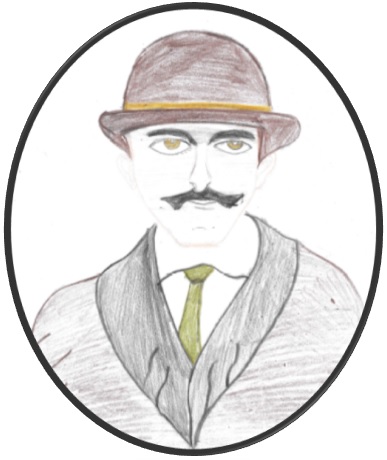
I. Albeniz (Spain): Iberia
J. Rodrigo (Spain): Concierto de Aranjuez
H. Villa lobos (Brazil): Bachianas Brasileiras
 A. Copland (United States): Appalachian Spring
Listening session: In the hall of the mountain king
In 1874 Henrik Ibsen, an important writer, asked the 30 year old musician Edward Grieg to compose incidental music for his poetic drama Peer Gynt.
 Peer Gynt tells the adventures of a boy with great imagination and dreams who always gets in trouble. It’s a round trip home and to the arms of a woman who has been waiting for him for all those years.
In one of these adventures he goes for a walk in the forest, Peer runs into a mysterious lady who tells him she is a princess and invites him to her kingdom. Peer finds out that she is the daughter of the king in the mountain and that her kingdom is in fact, a cave full of trolls! The trolls try to convince Peer to stay with them forever, so our main character can do nothing else but escaping.
This piece is made with two melodies in a call and response. Sentences always have this rhythm:

 The piece starts with Peer going down a mysterious cave where the king of the mountain lives. (bassoons, violoncellos and double bass in slow tempo)
Peer feels threatened and tries to escape from the cave in a hurry without being seen (pizzicato of oboe and violins)
The cave is protected by trolls under the king’s command, who discover Peer and start to pursue him (tempo gets faster, intensity and number of instruments increase)(2´09)
Peer successfully escapes (final tutti)(3´)
Impressionism in music
At the beginning of the 20th century there was a group of French painters who reflected the “impression” that a place or sound provoked in them. You surely know some of these painters, Monet, Manet or Van Gogh. Can you recognise them?
Click on the links and pay attention to how they draw, without outlines; only colours and sensations.
Musicians, observing those painters, decided to create the same trend but with music. It was called Impressionism and came from one of Monet’s paintings: Impression, soléis levan.

The most important composers were:
 - Claude Debussy (opera Pelléas et Mélisande, orchestra compositions Prélude à l’après-midi d’un faune, La mer, and for piano Images and Children’s corner)
- Maurice Ravel (compositions for piano Jeuxd’eau, ballet Daphnis et Chloë and the Boléro).
Listen to some of these compositions and explain in your own words what you feel.
Expressionism
Atonality, what do you think this word means? Let’s use Latin to discover its meaning:
A: means NOT Tonality: refers to tones
So, we discover that musicians did not use tonality in this movement.
With the intention of changing everything that was done before, they stopped using tonalities, dissonance, hops and rhythm were free and audiences didn’t like it because they were not really used to this out of tune and non-sense music.
This movement was called Expressionism and the most important composers were Second Viennese School:
- Shoenberg: Pierrot Lunaire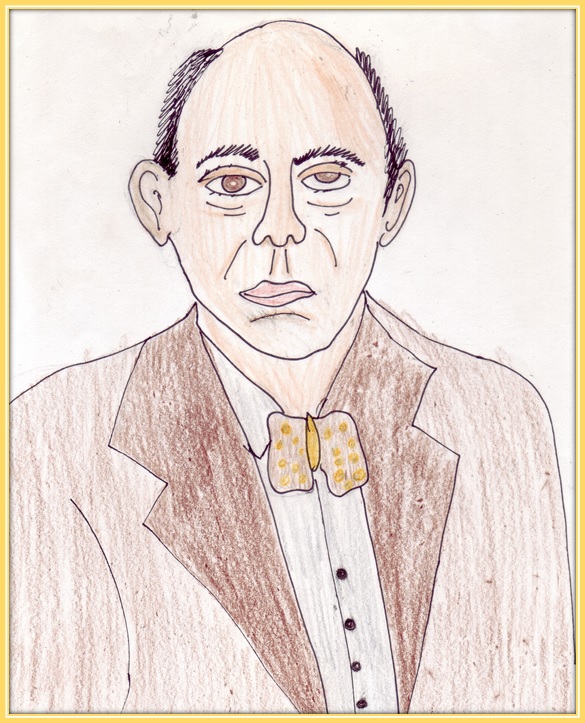
- Webern: Concerto for nine instruments
- Berg: Lulú
It also developed in painting and the idea was to show feelings, not just an impression like in the Impressionism. One of the most important paintings was Munch’s The Scream. Do you know it?

Dodecaphonism
Some of the composers got tired of so much freedom, and decided to create a new order in that tonality, with new rules and patterns to compose. That’s how dodecaphonism or twelve-tone system and serialism appeared.
Shall we go back to Latin to understand this word?
Dodeca: means 12 Phonism: refers to sound.
So dodecaphonism means that we use 12 sounds. That’s how they did it; they composed music in which they only used those 12 sounds they had previously chosen. In order to give it variety, they changed that series order; turn it around, in the form of chords, etc.
When they realised that order could also be applied to other elements in the scores the serialism emerged, where dynhamics, chords sequences, etc., were put in order.
Listen to the following score:

Let’s check the series of 12 sounds in this score: 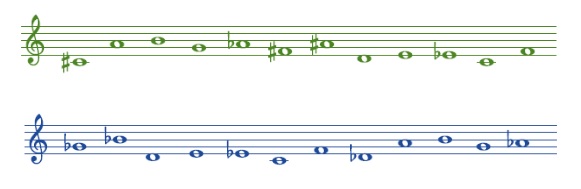

Who was Stravinsky?
 Let’s research this composer. He was one of the great figures in the 20th century and we will find out why.
Where was he from and where did he live?
What songs did he compose?
What movement did he belong to?
What did his music entail for the following generations?
Neoclassicism
All these changes were not well accepted by all the composers. Some of them preferred to go back to tonality rules and forms in Classicism. These composers were included in a trend called Neoclassicism. It took place mainly in France.
Their compositions followed the rules of previous periods but also included popular melodies like the ones in the circus or cabaret, giving music a different colour.
Some composers were E. Satie (Gymnopèdies) or D. Milhaud. (La Création du Monde)
Aleatoric music
In the middle of the 20th century music kept evolving and the main element was freedom.
Composers didn’t follow any rules. This affected not only the scores but also:
- How they were composed: new rules appeared like for example throwing a coin in the air and depending on how it fell, they would write the notes. How curious! Isn’t it?
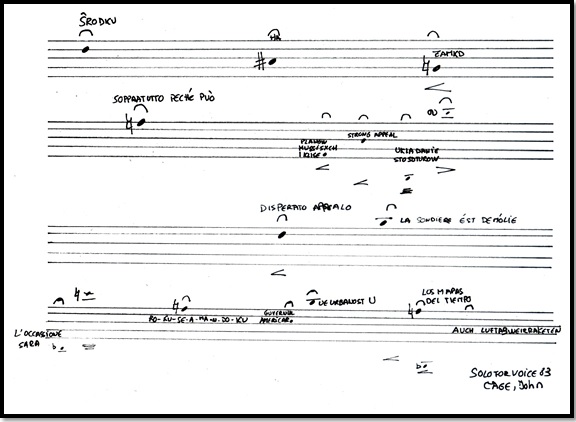
- How they were written: some like Kandinsky drew paintings that were scores, with a circle shape, without notes, with drawings that had the meaning each of them wanted to give them, etc.
 How they were performed: one composition was different in each concert, as musicians understand them in different ways and the composer used to write things like: play from the beginning and repeat as many times as desired.
- In the instruments used: new instruments appeared thanks to electricity, computers; but they also modified the ones that already existed and they included everyday objects like frying pans and pots. Singers sometimes shouted, blew and even burped or gargled. What a scene!

All these changes aimed at being original and breaking with all the previous things. Sometimes they also tried to shock the audience.
Some of the most renowned composers were:
-  John Cage: 4´33´´, Sonatas and Interludes for Prepared Piano.
- Ligeti: Lux Aeterna
- Stockhausen: Klavierstücke
Electronic music
One of the most important inventions in this century was the computer. And in music a device called synthesizer.
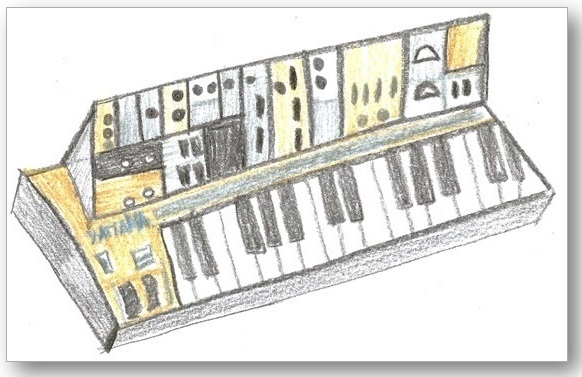
Do you know what it is?
Thanks to it, sounds were transformed giving place to unknown timbres until then. That’s how the first musical electronic compositions appeared. Such a discovery!
 Concerts were not as they used to be in previous periods; now there were musicians with their instruments in the stage and also recorders with tapes previously recorded. How modern!
Varese, Boluez o Cage were some of the composers who used these resources.
Minimalism
In the seventies some musicians were fed up of how others made music so difficult to listen to, it even seemed as if they didn’t want audiences to go to concerts.
So they decided to invent a new type of music that only used a few notes and repeated them again and again, in a constant rhythm with very little variation, resulting in an almost hypnotic music.
This trend was called minimalism.
The composers who followed it were Philip Glass or Steve Reich.
What did we learn today?
Read and complete:
Composing a symphony!
What about writing our own piece of aleatoric music?
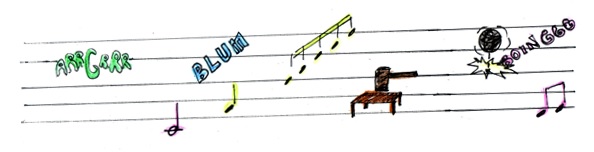
In this video you can see the Stripsody, a piece of music from an American composer and singer, Cathy Berberian, where comic book sounds are used (onomatopoeias).
From these ideas, and with what we’ve been seeing so far, let’s create ours.
Are you ready?
 To do it, we will use a dice and a list of the parts of the composition we want to randomly create: duration, notes, dynamics, and timbre.
The steps to follow are:
- A series of 4 or 8 notes (each one of the group suggests one or two.
- We select the first part we are going to create with the dice, for example the duration of the notes. If we get a 2, we can decide that the first one will be a half note, as it lasts two crotchets. And we will do so until we have the whole composition.
- And the dice game will be done in all the parts we want to.
- Then we can also use onomatopoeias or real sounds.
- To write it you can make use of the stave or drawings.
Here is an example:
Licensed under the Creative Commons Attribution Non-commercial Share Alike License 4.0