Saltar la navegación

Do you remember what you ate yesterday?

Do you remember what you ate yesterday? Or what did you have dinner the day before yesterday?

Many times, we are not aware of the food we eat. We eat routinely, distracted, watching TV, even mobile ...

To get a clearer idea of what your daily diet is like, you are going to take note of what you eat and what you drink. Your goal in this phase is to record what you eat for a few days, and save the data in a document.

Research

Food and nutritional values

In foods are present substances called nutrients , which are necessary for metabolism. The human organism needs a continuous supply of nutrients to be alive.

Nutrients, according to the amount in which they are present, are classified as macronutrients (they occupy a large part of food) and micronutrients (they are present in very small amounts). Look for information on what types of macronutrients and micronutrients exist: for example, on this page of the UNED website.

Energy value, carbohydrates, fats, proteins: a very important part of food labeling is nutritional information.

How to know the nutritional values of a food?

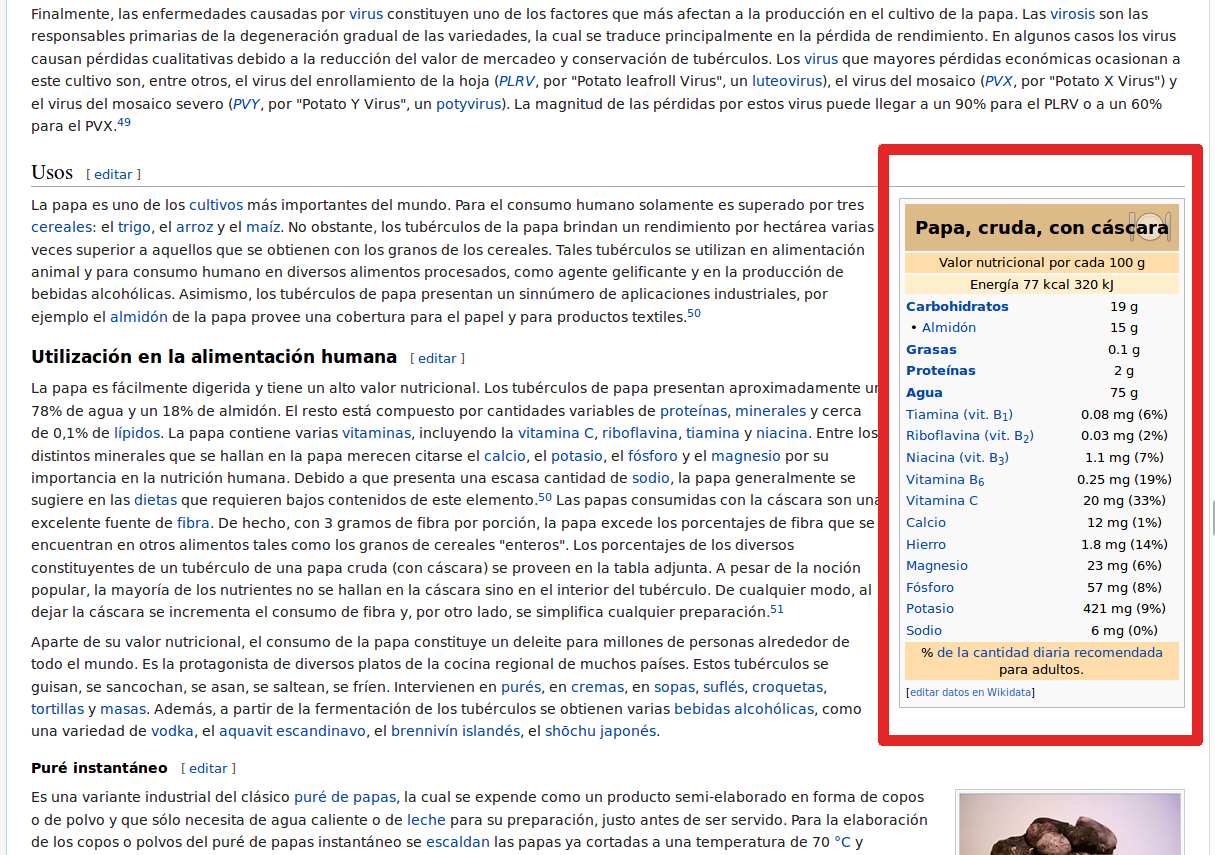
Packaged foods, except those with a single ingredient (such as bottled water or salt), must carry their nutritional information on the label. Unpackaged foods are not required to carry that label, but we can find their nutritional values on Wikipedia. For example, try to find the energy they provide and the amount of carbohydrates, fats and proteins in 100 grams of potatoes.

Food Record: write down what you eat

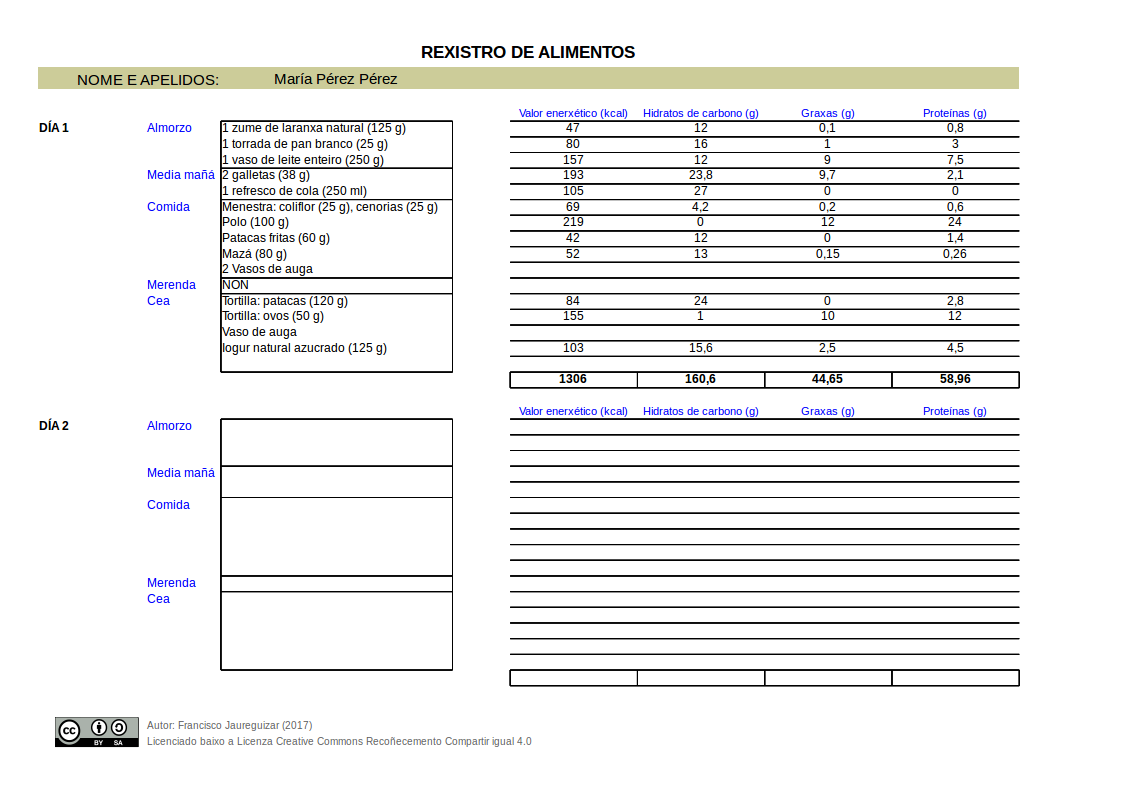
Rexistro de alimentos
Francisco Jaureguizar. Rexistro de alimentos (CC BY-SA)

We can keep track of our food by noting for a few days everything we eat. For this task, we can use a computer, making a spreadsheet, like the image. If you want to use this spreadsheet, you have it in ODS format, in this link. It opens with LibreOffice or by importing it into Google Drive.

Task

Develop a Food Record:

  • Each team records what their members eat and drink for two days on a shared spreadsheet in Google Drive.
  • In the Food Record the weight in grams of each of the foods ingested will be indicated.
  • For each food, the following nutritional values will be indicated: energy, carbohydrates, fat and proteins. It is not that the data that you put is exact (that would be very complicated to do). It is mainly that you are more aware of the nutritional value of each food you take.
  • In dishes that mix various foods, such as stews, soups or salads, it is not easy to determine nutritional values. What you can do is write down the values of the two or three main ingredients of the recipe.
  • At the end of the period, you will evaluate the main nutritional values. What are the two foods that have the most energy value? And the two that contributed more fat?

Assessment of the task

To evaluate the task, the following rubrics will be used:

Look at them carefully before starting work and check at the end if you fulfill the requirements contained therein.

Learning Journal

Write a new entry in your Journal now. Tell what you have learned making the Food Record.