The Republic (509-27 BC)
After the expulsion of the Etruscans, a new form of government was established, the Republic. With it the powers that monarchs had enjoyed exclusively were divided among the following institutions:
- Comitia or voting assemblies. They included all Roman citizens. They passed laws, elected magistrates and decided on matters of war and peace.
- Senate: this was composed of 300 members, who were former magistrates. It established laws, had control over magistrates and decided on foreign policy.
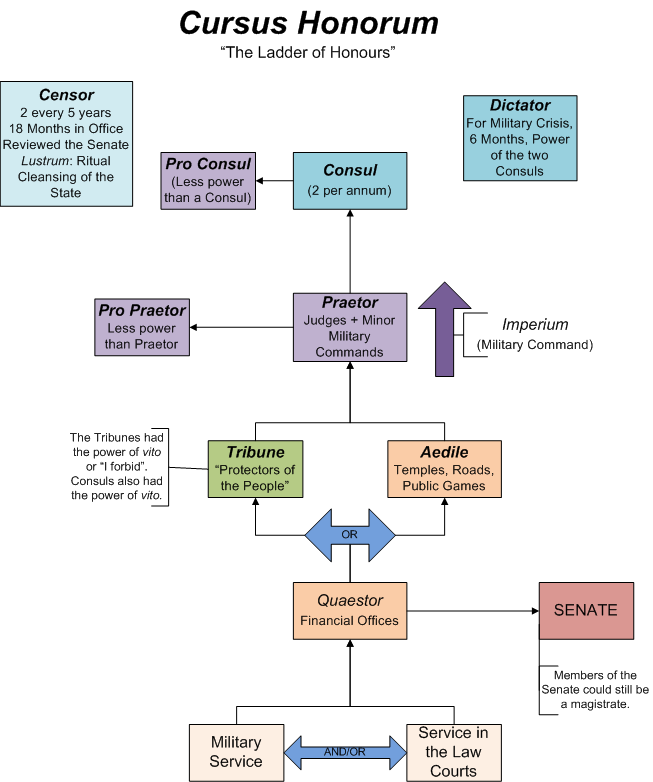
- magistrates: they held political, economic and military power. They were elected for a year. They were very similar to our ministers. The career of a Roman politician lasted 10 years, and it was called cursus honorum (the "sequence of offices" or the "ladder of honours", so to say). It consisted of four steps of increasing importance (quaestor, aedile, praetor, consul). No step could be skipped to get the following ones. The highest magistrates were two consuls who controlled political life and the army.
This means that the Roman Republic had its own system of checks and balances. The Senate nominated people to the office of censor and they could approve or disapprove any decisions made. Since the Romans did not want one man to make all of the laws, they decided to divide the power of the government into three branches: the executive branch, the legislative branch, and the judicial branch.
This diagram by CLIO History Journal will help you to understand the Roman political career.