The Monarchy (753-509 BC)
In the beginning Rome was governed by a king who was chosen by the most important families in the city, the patricians.
The king was helped by the Senate, an assembly formed by senators, who were the heads of the leading families.
For two centuries, four Latin kings and three Etruscan ruled successively (the Etruscans occupied Rome during the sixth century BC).
Etruscan domination ended in 509 BC, when King Tarquin the Proud was expelled after a revolt.

Wiki Article
Lucretia

'Lucretia' (1664) by Rembrandt van Rijn, National Gallery of Art, Washington, D.C.

'The Tragedy of Lucretia,' ca. 1500-1501, Sandro Botticelli, Isabella Stewart Gardner Museum, Boston
Lucretia is a legendary figure in the history of the Roman Republic. According to the story, told mainly by the Roman historian Livy and the Greek historian Dionysius of Halicarnassus (who lived in Rome at the time of the Roman Emperor Caesar Augustus), her rape by the king's son and consequent suicide were the immediate cause of the revolution that overthrew the monarchy and established the Roman Republic. The incident kindled the flames of dissatisfaction over the tyrannical methods of the last king of Rome, Lucius Tarquinius Superbus. As a result, the prominent families instituted a republic, drove the extensive Tarquin family from Rome, and successfully defended the republic against attempted Etruscan and Latin intervention. The rape has been a major theme in European art and literature.
The incident
Lucius Tarquinius Superbus, last king of Rome, being engaged in the siege of Ardea, sent his son, Sextus Tarquinius, on a military errand to Collatia. Sextus was received with great hospitality at the governor's mansion, home of Lucius Tarquinius Collatinus, son of the king's nephew, Egerius Tarquinius Collatinus, former governor of Collatia and first of the Tarquinii Collatini. Lucius' wife, Lucretia, daughter of Spurius Lucretius, prefect of Rome, "a man of distinction",[3] made sure that the king's son was treated as became his rank, although her husband was away at the siege. In a variant of the story,[4] Sextus and Lucius, at a wine party on furlough, were debating the virtues of wives when Lucius volunteered to settle the debate by their all riding to his home to see what Lucretia was doing. She was weaving with her maids. The party awarded her the palm of victory and Lucius invited them to visit, but for the time being they returned to camp.
At night Sextus entered her bedroom by stealth, quietly going around the slaves who were sleeping at her door. She awakened, he identified himself and offered her two choices: she could submit to his sexual advances and become his wife and future queen, or he would kill her and one of her slaves and placing the bodies together claim he had caught her having adulterous sex (in flagrante delicto). In the alternative story, he returned from camp a few days later with one companion to take Collatinus up on his invitation to visit and was lodged in a guest bedroom. He entered Lucretia's room while she lay naked in her bed and started to wash her belly with water, which woke her up.
Adapted from "http://en.wikipedia.org/w/index.php?title=Lucretia&oldid=471730890"
This article is licensed under the GNU Free Documentation License. It uses material from the article "Lucretia".
 Think about it
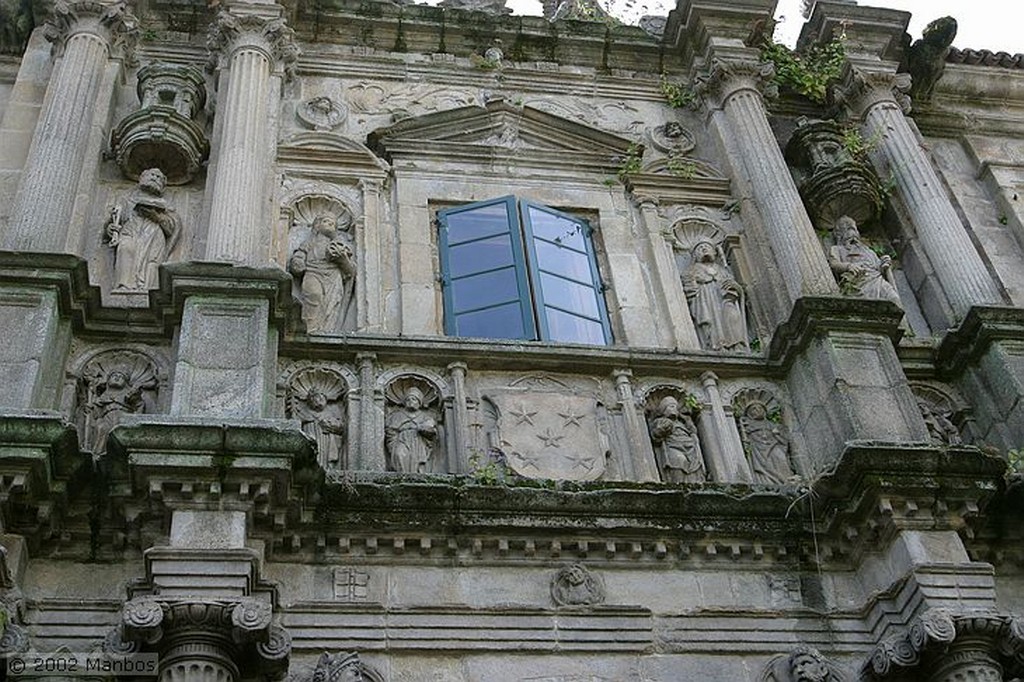
This is a photo of the façade of Fonseca´s College (modern University Central Library) in Santiago de Compostela. You know who the lady at the bottom of the photo is? Why is she in this façade in the finis terrae, so far from Rome and apparently its tradition?

Activity
Prepare a presentation or a video with all the images of Lucretia you can find. Put on each slide the name of the author of the painting or of the sculpture and the date of composition.
If some of you feel so confident as to do something similar to this rap, this will be very well accepted!