"Solfeggio"
What are we singing?
"Unha vella tiña un can" (An old woman had a dog) is an anonymous traditional Galician song, but it has many versions in other countries like Portugal.

As you can see the lyrics are summative, whenever an animal is added there will be new phrases. It is also important that it includes onomatopoeias that are animal sounds. Lyrics are very funny and its purpose is to entertain.
"Waltzing Matilda" is the most famous Australian song. It is known worldwide. It was even suggested as national hymn and it has its own museum. It was composed by Andrew Barton Paterson in 1895.
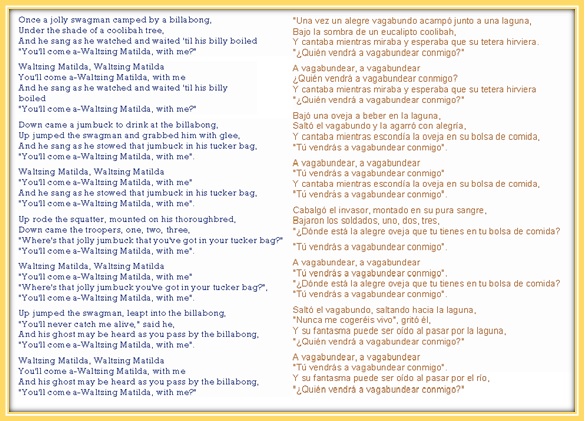
It tells the story of a vagabond who camps near a lagoon, finds a sheep and feeds himself with it after stealing it. The landowner finds out and calls the police to chase him. Before he gets caught, the vagabond jumps in the lagoon and dies after drowning. At the end of the song, the ghost of the vagabond invites you to wander with him.
It was taken as the hymn of the poor, against the power of the richest.
"Waltzing Matilda", literally means “Dancing a waltz with Matilda”, but here "Waltzing", makes reference to the action of a poor person walking (wander) and Matilda, refers to the vagabond.
Time signature: 6/8
Up until now, we have been working with times signatures 2/4, 3/4 or 4/4.
In "Unha vella tiña un can" song we are going to use 6/8. The difference is that in each pulse there were 2 quarters and now there are 3.

To practise this time signature we are going to do different exercises:
- We start by walking around the class saying 1, 2,3 in each step.
- We repeat 3 syllable words like paragraph to mark 3 pulses.

Offbeat notes
To be able to work with the instrumental Orff, we need to learn a new element: the offbeat notes.

These notes are placed in the weak part of the time preceded by a rest, as the example shows.
The scales
We are going to talk about some of the scales that are used in the different kinds of music around the world we’ve been seeing:
- The pentatonic scale: it’s a type of scale with 5 sounds (penta= five + tonic=sound). This scale was mainly used in Chinese and Japanese music, although nowadays there are many types of music that use it like jazz or disco music among others.
- The blues scale: this style was developed in North America with clear influences from African music. The scale has 8 sounds.
- The klezmer scale: musical style that develops in Central Europe by Jews. It sounds like this:
- The Arabic scale: it is used in the music of North Africa.
Licensed under the Creative Commons Attribution Non-commercial Share Alike License 4.0