"Solfeggio"
Change of time signature: 6/8-2/4
 The time signature in the score Memory is 6/8, but if you pay attention, it appears in the middle of a 2/4 time sinature.
And how do we do it?
 The change from one time signature to another, as we’ve already seen in previous units, is called equivalence, and in this case is beat=beat
The 6/8 time as well as the 2/4 have 2 pulses, don’t they? The difference is that in a pulse of the 6/8 there’s space for 3 eighth notes and in the 2/4 there’s space for 2. As there are fewer notes in the 2/4, when we get to it, it’ll seem that we are slowing down, but it’s not like that. The pulse is always the same.
Listen to this example with the metronome, and then you will realize that the metronome never changes, what means that the pulse remains the same.
Practise it!
A broken chord or arpeggio
As we have already seen, there are two parts in a song: melody and accompaniment.
A melody carries the lyrics of a song, whereas the accompaniment is the support that complements that melody.
The accompaniment is harmonic that is it is made up of chords.
 A chord is a group of 3 notes that sound at the same time, and they are at a 3rd distance.
 But sometimes these notes do not sound at the same time; they do it separately, giving place to the broken chords or arpeggios, as it happens with the accompaniment in Memory.
The arpeggio is divided between the Bass Xylophone and the Metalophone 2. 
Listen to the following audio to see the difference between a chord and an arpeggio:
Repeat signs
We already learnt the repeat signs. In these songs they reappear.
Do you remember how they are made?
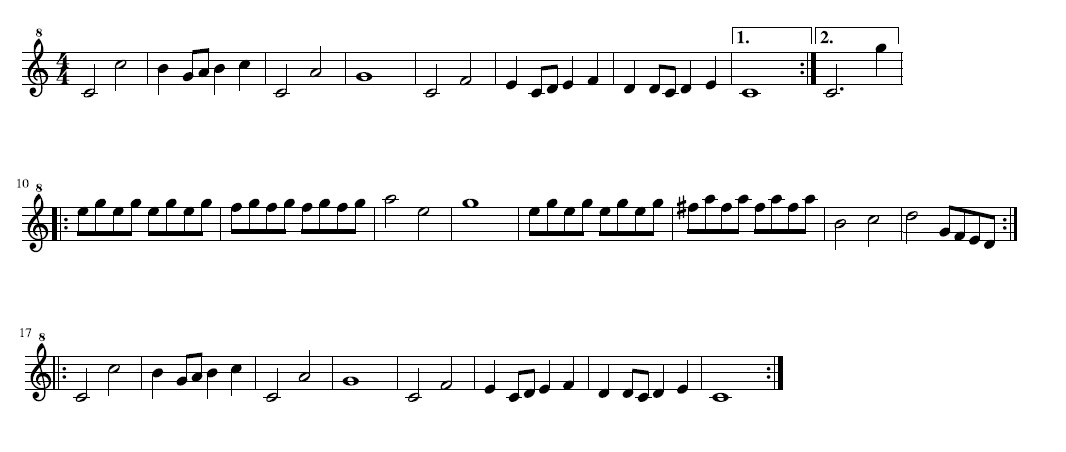
 Remember that the first time you must do until the 1st, and when it repeats you have to jump that fragment and do the 2nd.
There is a new indication. At the end of the score D.D. al Fine.
It means that once you do the repetition, you have to go back to the first part again and finish where it says fine.
Form
We are going to have a look at the score Over the rainbow. Taking into account the repetitions, it would be:

herefore, it is a ternary form A B A, as w ego back to the first part.

What did we learn?
Solution
Solution
Licensed under the Creative Commons Attribution Non-commercial Share Alike License 4.0