"Solfeggio"
What do we know about this composition?
The Seikilos Epitaph is the oldest preserved and complete musical composition, including musical notation.
It was found engraved on a tombstone near the Turkish city of Ephesus.
This is a transcription from the tombstone:
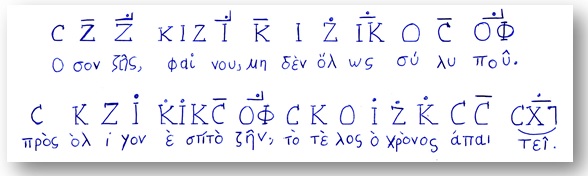
The musical notation is not the same as the one we know, right? They are signs, similar to the letters, that indicate the different pitches. (alphabetic system).

The lyrics that appear in our score correspond to the pronunciation, not the real text, so we can sing it.
The translation of the text would be:

Time signature: 3/4
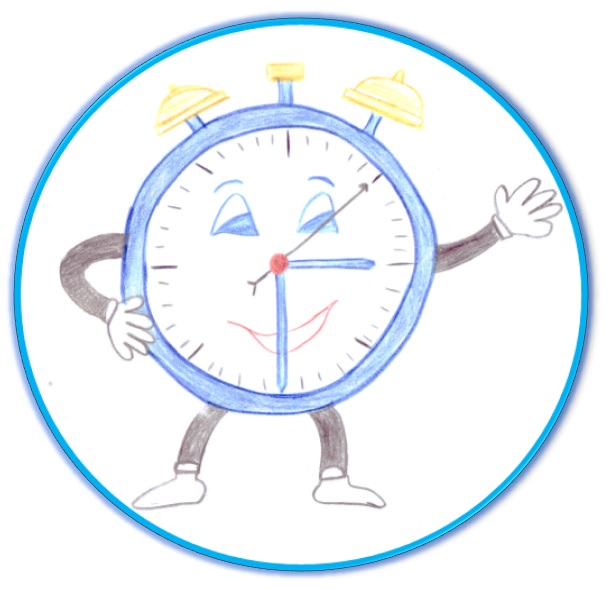 Do you remember what beat is? Beat is the basic unit to measure time. A good example is the hand in your watch: it signals the beat every second. If you have a watch you can check it.
A group of several beats is called bar. Remember that we can group them every 2, 3 or 4 beats, resulting in the bars we all know: 2/4, ¾ and 4/4. In these scores it will be 3/4.
The bar is represented as a fraction, and as you have already studied in Maths, it is made up of two elements:
- Numerator: it indicates the number of beats: 2, 3 or 4. In this score it is 3.
- Denominator: it indicates the note that will occupy that beat. In this score it is 4. In order to know what this number means, we will play a logic game where the whole note will be the base, asking ourselves the following question (remember the notes we know: whole note (4beats), half note (2 beats), quarter note (1 beat) and eighth note (half beat):
How many ... (note we want to know) are there in a whole note?
In the score beat is marked by the quarter note.
So the question would be: how many crotchets/quarter notes are there in a whole note? There are 3 quarter notes. That is why the number in the denominator is 4.
Therefore the 3/4 means that there are 3 quarter notes in every bar.
Check it in the score! 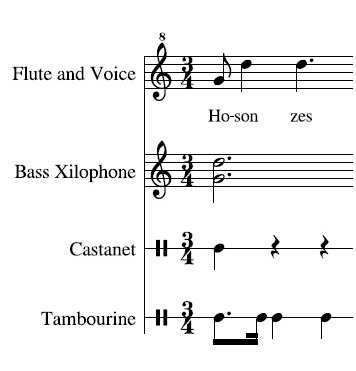
Dotted note
In this score there is a new symbol that we learnt last year. Do you remember how it is called?

 It´s a dotted note!
It is a symbol that is placed on the right of the notes. It adds half of the note.
The following examples will help you to understand it better:
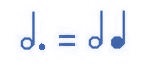
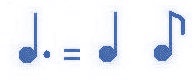
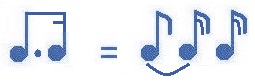
There is another symbol in the accompaniment : 
It´s the same dot but in smaller figures (eighth note).
Look at these pictures and you will understand it a bit better.
Fermata and repeat sign
There are some symbols in the score that we learnt last year. Do you remember any of them?
This is the first one: 
It is called fermata and it means that we have to lengthen the duration of the figure to which it is attached
It is always placed over or under the note or rest.
The next symbol is this: 
It´s a type of double bar (repeat sign) that indicates that we have to repeat the score from the beginning.
Syncopation
In the score there is these rhythms; 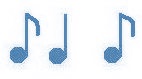 and
and 
Do you remember it?
They are the syncopations: when a note is in the weak part, it is lengthened until strong part.

The following audio will help you to practise the syncopation,

Form
The form of a score is its structure.
The most used forms are the binary form and the ternary form. They have two or three parts, respectively, as their names indicate.
In order to point out the different parts in a score the capital letters of the consonants are used: A, B, C, D, etc.
If two parts are equal, but they have small differences (different letter and same music, different ending, etc) they would be called A and A’ (prime A).
The most usual form in music nowadays is the rondo: ABACAD, that is, verse and chorus.
Another form we are going to learn about is the canon.
The form of this song is binary: A B, because its two parts are different. porque sus dos partes son diferentes.
What symbol is helping us to indicate the ending of each part?  The fermata!!!
Check it in the score and the audio!

Let´s practice!
Solution
Ear training
Creating new lyrics
Let´s write new lyrics for this greek music.
You can make reference to what the real text says (time, life, etc) or another topic you like.
Pay attention to the number of notes in each sentence to make it coincide with the text you invent.
Let your imagination fly!
You can do it in English, Spanish or Galician.
(If you need to see an example, press the feedback)
Licensed under the Creative Commons Attribution Non-commercial Share Alike License 4.0