What reasons do we have for practicing sports? Have a good time? Be in shape? Feeling good?
Is the practice of sport good? To all the ages? For anyone?
Is physical activity the same as exercising or practicing a sport?
What reasons do we have for practicing sports? Have a good time? Be in shape? Feeling good?
Is the practice of sport good? To all the ages? For anyone?
Is physical activity the same as exercising or practicing a sport?
We call physical activity to any body movement produced by skeletal muscles that entails an energy expenditure above resting level.
Ministerio de Sanidad
Exercise is a subcategory of physical activity that is planned, structured, repetitive, and aims to improve or maintain one or more components of physical fitness..
Beyond exercise, any other physical activity that is done during leisure time, for transport to get to and from places, or as part of a person’s work, has a health benefit.
WHO | Physical activity
Therefore, physical activity and exercise are not the same. The term «physical activity» is broader than the term «exercise». Exercise is a type of physical activity, but there are many others. We can perform physical activity playing, working, doing household chores, when we move between places...
Different lengths of physical activities are recommended for each age bracket. The activity that a child has to do is not the same as an adult or a person of 65 years or more. Search the information on the WHO website, specifically on the page dedicated to Physical Activity, to know what is recommended for each age group.
Physical activities may have varying degrees of intensity, depending on the effort required. On the website of the Ministry of Health on physical activity, three levels are established for the intensity of physical activities: mild, moderate and vigorous.
It allows you to speak or sing effortlessly while you practice it. For example: walking at a slow pace.
The sensation of heat increases and a slight sweating begins. Also increases heart rate and respiratory rate but you can still talk without feeling the lack of air. For example: brisk walking (more than 6 km/h) or cycling (16-19 km/h).
The feeling of heat and sweating is stronger. The heart rate is higher and it is harder to breathe, making it difficult to talk while you are practicing. For example, running or cycling by pedaling rapidly (19-22 km/h).
Source: Ministerio de Sanidad, Servicios Sociales e Igualdad (link).
Each of the teams collects information on the internet about physical activity in adolescents.
The teams create a text document entitled "Benefits of physical activity" in Google Drive.
A table like the following will be included in the text document, and the data of the empty cells will be covered.
| WHO Recommendations | 5 to 17 years | 18 to 64 years | 65 years or older |
|
Minimum duration of moderate physical activity (weekly minutes) |
|||
| Minimum duration of intense physical activity (weekly minutes) | |||
| Duration of physical activity to get more benefits (weekly minutes) |
Then, in the same text document, you will answer the following questions:
The report will be shared with the teacher.
To evaluate the task, three guiding documents, called rubrics, will be used.
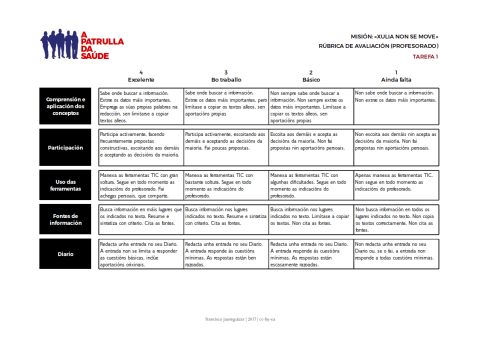
Look at them carefully before starting work and check at the end if you fulfill the requirements contained therein.
(HINT: You can also look at the rubric for teachers, not only the rubrics for students.)
Write a new entry in your Journal now. Tell what you have learned in this task.
Licensed under the Creative Commons Attribution Share Alike License 4.0