Bathing
 From our Correspondent in Ancient Rome
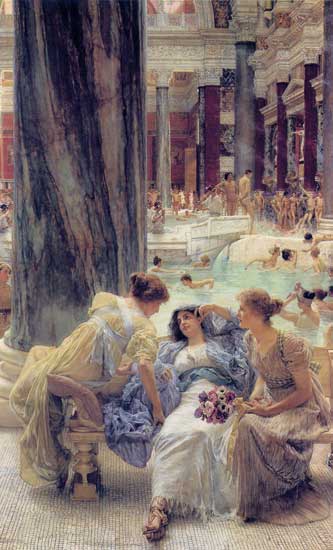
The baths were a place of leisure time during many Romans daily routine. People from nearly every class - men, women, and children - could attend the thermae, or public baths, similar to modern day fitness clubs and community centers.
The two most well preserved baths of ancient Rome are the baths of Diocletian and Caracalla. Diocletian's baths cover an enormous 32 acres. The baths of Caracalla cover 27 acres.Towards the center of the Roman baths, adjoining the dressing room, could be found the tepidarium, an exceedingly large, vaulted and mildly heated hall. This could be found surrounded on one side by the frigidarium, a large, chilled swimming pool about 200 feet by 100 feet, and on the other side by the calidarium, an area for hot bathing warmed by subterranean steam.
Hot air and steam baths had been known to the Greeks as early as the 5th century BC, and have been found in Italy dating back to the 3rd century BC. The original thermae were small, hand activated individual sweets called balinae. By the 1st century BC, hypocaust heating allowed for the creation of hot/cold rooms and plunge baths. Bathing quickly became a communal activity. The term thermae was first applied to the baths built by Aggripa in the last 1st century BC. Emperors later built gradually grander baths, and the thermae became an Ancient Roman tradition.
Not only were the baths meant for leisure, but also, for social gathering. In addition to the bathing areas could be found portico shops, marketing everything from food, to ointments, to clothing. There were also sheltered gardens and promenades, gymnasiums, rooms for massage, libraries, and museums. Complimenting these scholarly havens were slightly more aesthetic marble statues and other artistic masterpieces.
Excerpted from http://library.thinkquest.org/26602/entertainment.htm

Actividad
Do you fancy joining all these people inside Caracalla's Baths and taking a virtual stroll around this magnificent building? Just click on the photo. Don't forget to take notes because you will have to answer some questions related to your visit.

Reading Activity: Living close to the Baths
According to what Seneca says below, living right over a bathing establishment could be risky. Let's read this funny description by our writer from Corduba:
1. Beshrew me if I think anything more requisite than silence for a man who secludes himself in order to study! Imagine what a variety of noises reverberates about my ears! I have lodgings right over a bathing establishment. So picture to yourself the assortment of sounds, which are strong enough to make me hate my very powers of hearing! When your strenuous gentleman, for example, is exercising himself by flourishing leaden weights; when he is working hard, or else pretends to be working hard, I can hear him grunt; and whenever he releases his imprisoned breath, I can hear him panting in wheezy and high-pitched tones. Or perhaps I notice some lazy fellow, content with a cheap rubdown, and hear the crack of the pummelling hand on his shoulder, varying in sound according as the hand is laid on flat or hollow. Then, perhaps, a professional comes along, shouting out the score; that is the finishing touch. 2. Add to this the arresting of an occasional roisterer or pickpocket, the racket of the man who always likes to hear his own voice in the bathroom, or the enthusiast who plunges into the swimming-tank with unconscionable noise and splashing. Besides all those whose voices, if nothing else, are good, imagine the hair-plucker with his penetrating, shrill voice, - for purposes of advertisement, - continually giving it vent and never holding his tongue except when he is plucking the armpits and making his victim yell instead. Then the cakeseller with his varied cries, the sausageman, the confectioner, and all the vendors of food hawking their wares, each with his own distinctive intonation.
Seneca, Moral letters to Lucilius, 56, 1-2. Excerpted from Wikisource
You should know
The Romans were much more uninhibited than us in some matters. For example, toilets. These were totally communal, ie, all together including men, women and children. Surprisingly, they also shared the same "utensils" to clean themselves after... It is better to watch this funny video to get the complete idea.