THE GALICIAN CASE:
THE OWN CULTURE THROUGH THE IMAGES OF THE ILLUSTRATED ALBUMS
Following structuralist conceptions, we may classify those elements in different systems of interrelated symbols, in different categories:
- Materials
- Organization
- Knowledge
- Communicative codes
- Emotions.
Any culture may show itself through these elements, and the same as my Nigerian colleagues were showing their particular vision of the world, from their portion of the world, and even showing themselves through their productions, the same may happen, and actually happens in the illustrations from Galician literary books for children.
Taking a look at the
images from the production of books in the Galician language, intended
for pre-readers, we may have a clear photograph of the cultural features
which are transmitted to the younger ones by means of them.
We can also infer from this observation that in many cases the information
conveyed by the image goes beyond what the text explicitly says.
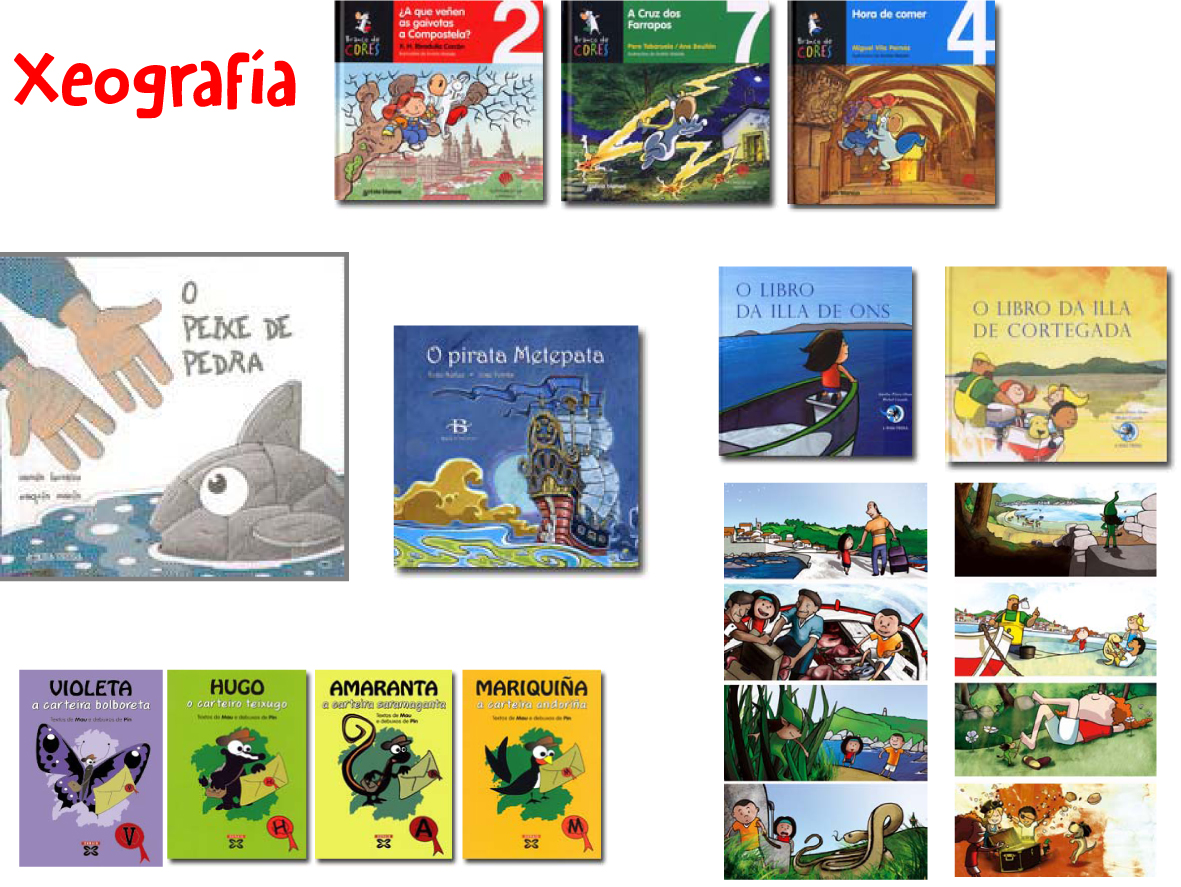
Considering the material heritage one of the most relevant for a culture, and making subdivisions to analyse them in detail, the first field we come across is the territory.
The Galician land is clearly defined by its limits: the sea and the mountain.
In between there is the countryside, traditionally exploited as one of
the main economic sources. A considering amount of books for young children
deal with Galicia and parts of it as one strong presence.
Sometimes, even when the main aim is not the territory, this still appears, as in a second stage, revealing the landscape, the cliffs, the sea, the mountains, and many real settings which are not specifically natural: cities, villages, towns. Some collections have even been created to show places to children, and images are the first contact which pre-readers have with them.
In some other cases, books designed to promote a city show on images many more details than what words might tell, as it happens with books illustrated by Andrés Meixide.
The Galician territory is given special treatment as far as natural reserves
are concerned: the sea and the countryside are present in many of the
illustrations, and they usually expand the information provided in the
text: a wide presence of plant species, animals, habitats, and tiny details
of a rich flora and fauna.
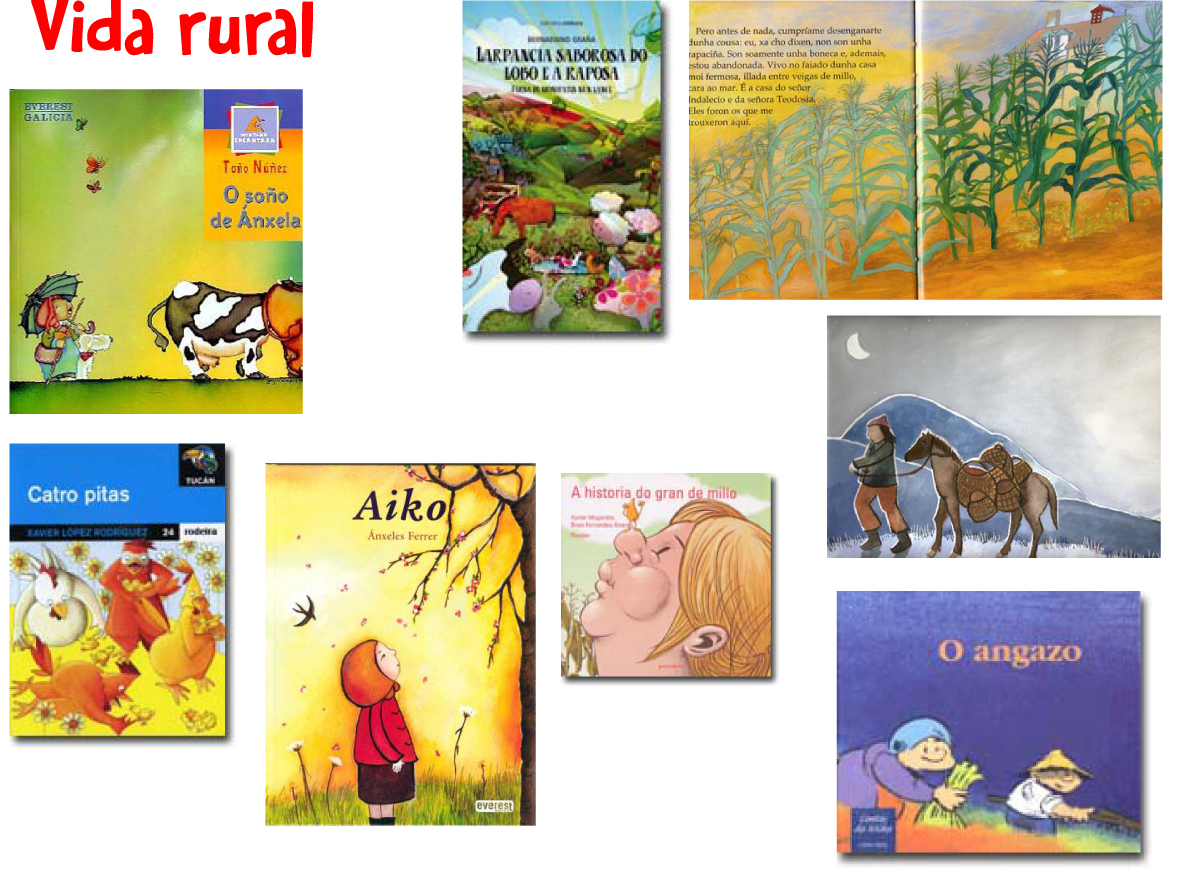
Readers can see rural life as a confluence of different various elements: traditional houses, farm animals, landscape, and, what may be more interesting, traditions and ways of life.
A good example of this is "O soño de Ánxela " (Ánxela's dream), in which the visual story takes us back to old ways of living in the ancient mountains of Os Ancares. Related to this, in books like "Aiko" a sociological phenomenon which was inevitably associated to villages, emigration, appears beautifully depicted by the melancholy scenes of a father leaving the home land.
Traditions and popular costumes are kept in illustrations, this way being preserved visually in a changing world, when the countryside is suffering strong transformations.
Something similar happens with the continuous presence of the sea. Traditional boats and ships, old fishing skills, and animals not only as such, but also as part of the Galician gastronomy.
And the sea represented as the giver and taker of lives, the path to leave and migrate to foreign lands, the eternal menace.

Flora and fauna are two essential ingredients of the territory: they are constantly mixed up with vast landscapes, and microhabitats.
They bring pre-readers the taste for details and observation in the wild, like in "Bechos pequerrechos" (Tiny bugs), where María Lires helps children look at the small big worlds of little native animals.

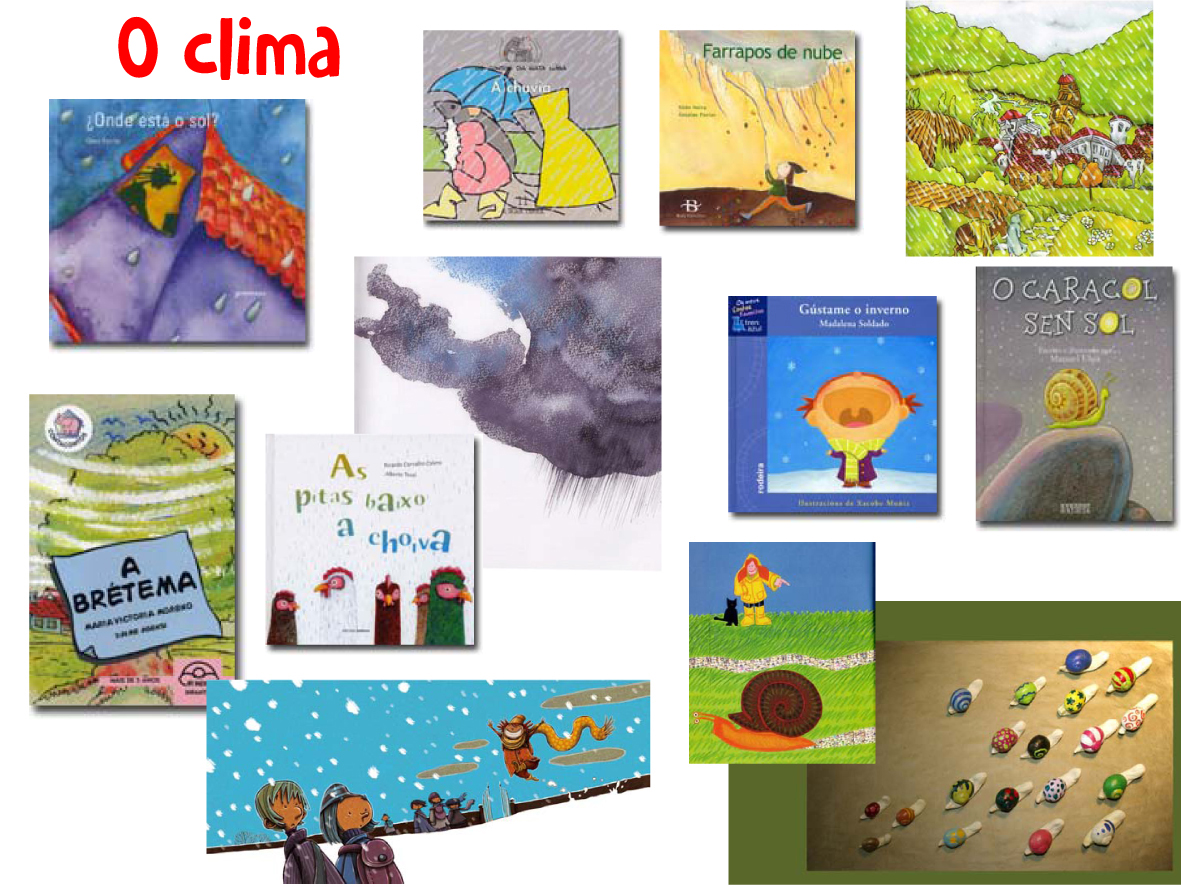
An aspect which deserves special mention is the weather. Alternating from humid to wet, usually cloudy and sometimes misty, it is present in many illustrations, usually conveying the text high doses of subjective feelings: the melancholy of grey clouds full of rain, or the absence of sun and warmth.
The weather is present even when it is not the topic of the book: the appearance of snails reminds us of the everlasting wet atmosphere.

Gastronomy, as a result of natural products, shows us interesting images of families around the table, of festivities which might not exist without sharing food.
A good metaphor of it is the family of snails eating a Galician pie drawn by Óscar Villán explaining graphically the traditional millenary behaviour of parents and children at meals.

And at the end of the material heritage is art, architecture, and human creations which define the Galician style: in a considerable number of stories taking place in the countryside we can see traditional stone houses, as well as the surroundings of them (barns, the orchards, and similar elements). But going further, we can also know, thanks to illustrators like Kiko da Silva or Meixide, specific details of the Romanesque and Gothic art in Santiago de Compostela.
Festivities and celebrations are
part of the immaterial inheritance, and they are inevitably related to
organizational features like the family. Many traditional celebrations
may be visually understood by children thanks to the images of the books:
dances around the tree, special costumes, jumping over the bonfire, and
other must be seen to be fully comprehended, as they are in Jacobo Fernández's
work.


Considering experiences, history and even the explanation of its own identity, we come to myths and legends. This is field in which illustration is absolutely necessary to visualize the inhabitants of the forests, the mountains, and fictional historical protagonists of stories still told today. Thanks to the illustrators' interpretations of them, many are preserved and re-drawn by children at school, to celebrate, for example, the traditional winter solstice.
The special communicative codes shared by the members of a culture represent one of the most relevant aspects to define it: the language.
The Galician language has been the topic, itselt, for many books for pre-readers: albums about riddles, sound poems, and the self analysis of the code have jumped to illustrations, as the final means to explain them. The five vowels, drawn as five women in Maife Quessada's illustrations, bring the five sounds to children in an inductive way. In another book, "O peizoque Roque", a little bird grows thanks to eating the words he learns.
Even music
has its place in illustration, in wonderful images like the ones in "A
cantiga do mazarico", where we can find a synesthetic game of colours
and sounds.
The interest for the linguistic code
has even brought books based on the lives of relevant Galician
writers. The illustrations humanize authors, transporting them
to readers as a kind face of literature.

Finally, and getting deep into the subjective elements of a culture, we can mention the traditional Galician humour as another character present in many works.
Remembering the theory of the overflowings of illustration, we see it amplify stories, details, and even create new secondary plots which are not present in the main tale.
It is quite common to find this practice in authors who also work on graphic humour for other media, like the press.

TWO PARADYGMATIC CASES AT AN INTERATIONAL LEVEL:
ROBERTO INNOCENTI AND SHAUN TAN
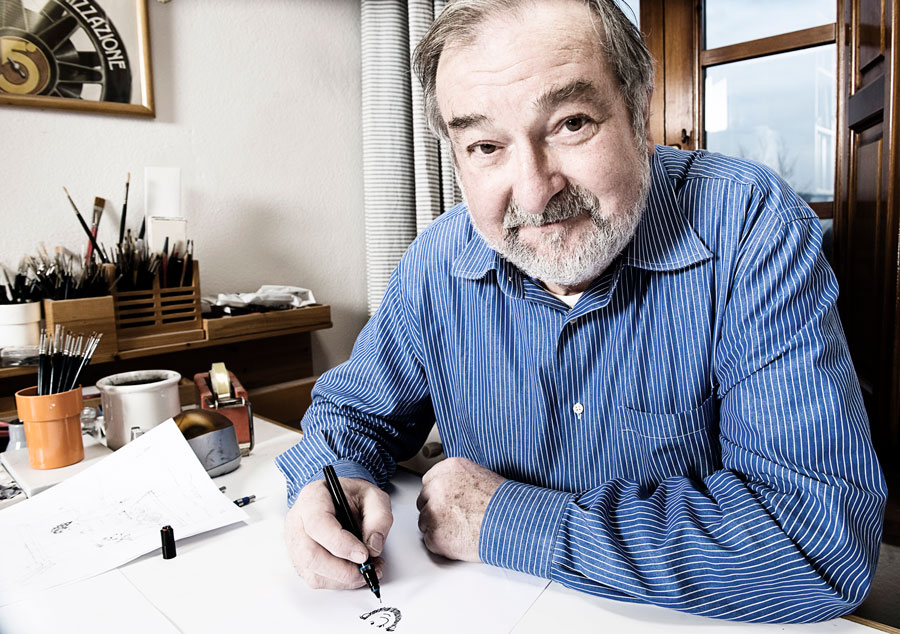
Roberto Innocenti was born in 1940 in Bagno a Ripoi, a little town next to Florence, As a teenager, he was a worker at an iron smelting company. He did not study art, and when he was eighteen, he settled down in Rome, where he worked at an animation studio, and also as a banner designer.
Some of the banners he made for the Giunta Regionale Toscasa were later published by the prestigious Graphic Annual.
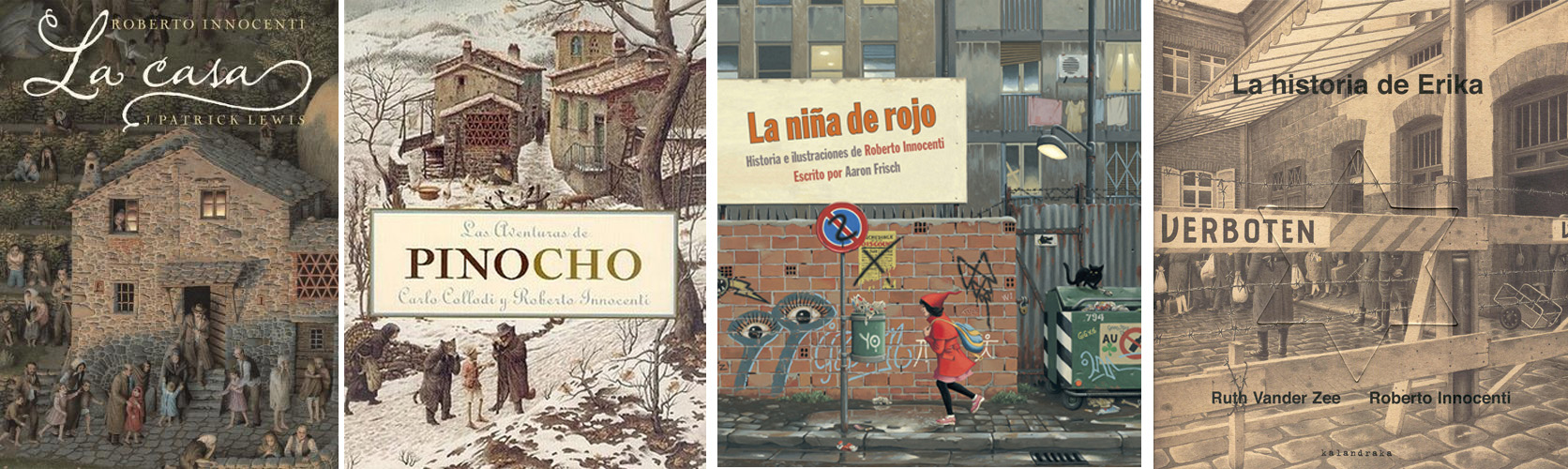
We can say he is one of the most important illustrators with a realistic style at an international level, for his exquisite care with details, as well as for his deep work in investigation and documentation.
Let us analyse one of his most emblematic works: WHITE ROSE (1985).
WHITE ROSE (1985)
In this work we can appreciate, as in all his books, a special look on details, on atmospheres, on the recreations of atmospheres. But here, in a very special way, something calls our attention: his interest for showing hard realities to children, in a very unusual way. Warsow Guetto is the setting of the story, and terrible things happen in them, which today are not commonly shown in children's books.
Innocenti himlsef speaks about this intention, and says: "Adults, parents, the children's protectors, want things for them which do not cause harm. They believe it is better for children to live in a sweet, morbid, ethereal, childish, reduced and protected world. This has brought about a preference in the editing world for an illustration with childish stereotypes, which seem to have good results. Thus, they do not assume risks. Children accept it maybe because it is offered as something suitable for them. But thene there is a moment when they get bored of it all, because it is always the same. This artificial way of educating demands very little from the artist. I believe children are more intelligent and brave. Anyway, it is difficult to say who is right or not".
We can see how Innocenti bases his work on real photographs from Warsow ghetto, to portrait scenes of very cruel historical moments, like this:
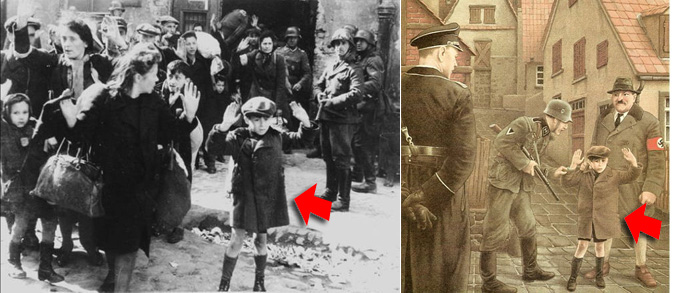
One of the interesting aspects of this work lies in observing the way he regulates the information between the narrative voice, the information conveyed by images, and the reader's historical knowledge: the boy does not understand the meaning of the flags haging everywhere. However, the reader does know this. There is a very interesting ambiguity between what the protagonist kid perceives, and the historical knowledge the reader has, because he really knows what is happening. This provokes a special subtile dramatism.
Besides, the hard work carried out by Innocenty in documentation takes us to a special approach to the historical facts, for the quality of the recreation of buildings, uniforms, clothing in general, atmospheres, etc.
WHITE ROSE is not a "protective" book. And it had to be Delessert, with his open view, free of prejudices, who dared to publish it.
OTHER REMARKABLE WORKS:

Un exemplo moi especial: "A ÁRBORE VERMELLA" (2001) Shaun Tan was born in 1974. He is an Australian illustrator and writer. In 2011 he received the Memorial Astrid Lindgren Award and one Oscar to the best animated short film, for the adaptation of his "The lost thing".
And as Innocenti looked for details and extreme documentation, we can observe in Shaun Tan's work a different trend: the recreation of oniric worlds. Very often he also works hard on documentation, as in "Emigrants". But most of the time he provides his illustrations with non real aspects, usually dreamt, possible, making it possible to mutiply the stories to infinite interpretations.
One very special example: "THE RED TREE" (2001) "
THE RED TREE

This is a masterpiece without a defined, clear narrative line. It is more a sequence of imaginary free autonomous worlds, which invite readers to draw their own conclusions, as the text, also written by him, conveys another open undefined story.
Then the interpretation possibilities are many, because the book is based in that (so human) impulse to describe feelings and sensations with metaphors, in this case visual ones: storms, closed bottels, huge fish, light and darkness, the rainbow, etc.
The progatonist, a girl with a fragile look, experiments some feelings, and carries out a real trip through many of them: frustration, solitude, lack of knowledge, loss, but also hope, and the vision of light through the tunnel.
When someone reads this work, he immediately realises it is not only one story, but many: we can all see ourselves portrayed in this girl's life, and every time we go back to the text (and the images) we experiment new meanings thanks to the powerful visual metaphors that come across along the pages.
What is the meaning of RED TREE? It depends on the reader, on the reader's circumstances. As the book allows us to project an unlimited series of emotions on the images (and on the text), it gives us an unlimited series of readings, too.
A pesar de que hai unha especie de "remontada" emocional cara o final do libro, a predominancia de sentimentos negativos é a norma na obra. Shaun Tan explica así a súa decisión:
"Algúns lectores téñenme preguntado por que as miñas imaxes son a miúdo sombrías, e creo que a razón é esa, porque me atraen máis as cousas que non acaban de estar ben, como as inxustizas sociais e medioambientais de Os coellos, a apatía social de A cousa perdida, ou incluso as ideas autodestrutivas de O visor. Creo que ese tipo de cousas son interesantes dende un punto de vista artístico, quizais porque non son temas resoltos, como un quebracabezas".
Even though there is a kind of positiveness by the end of the book, the predominance of negative feelings is nearly a norm in the whole work. Shau tan explains his decision with these words:
"Some readers have asked me why my images are often sombre, and I believe the reason is because I feel a certain attraction for the things which have not ended up well, like the social or environmental injustices of The rabbits, the social apathy of The lost thing, or the autodestructive ideas of The visor. I think these type of things are interesting from an artistic point of view, maybe because they are not solved topics, like a puzzle".
VIDEO VERSION OF "THE RED TREE": CLICK ON THE IMAGE

