COVERS AND BACK COVERS
ENDPAPERS
COVERS AND BACK COVERS
In
many illustrated albums the cover or back cover have a very important
function in the work. We may find different cases:
- A "bait" to attract readers to the book.
- A compiling element of the ingredients that apear in the story.
- And anticipation of the story.
- An amplification of the story.
- And many more.
In numerous occasions the cover is related with the back cover. When they are thought consciously, taking advantage of the possibilities between both, then they become narraive elements, sometimes descriptive or even premonitory.
VERDEDADES
(Yolanda Castaño / Xosé Tomás)
Biblos
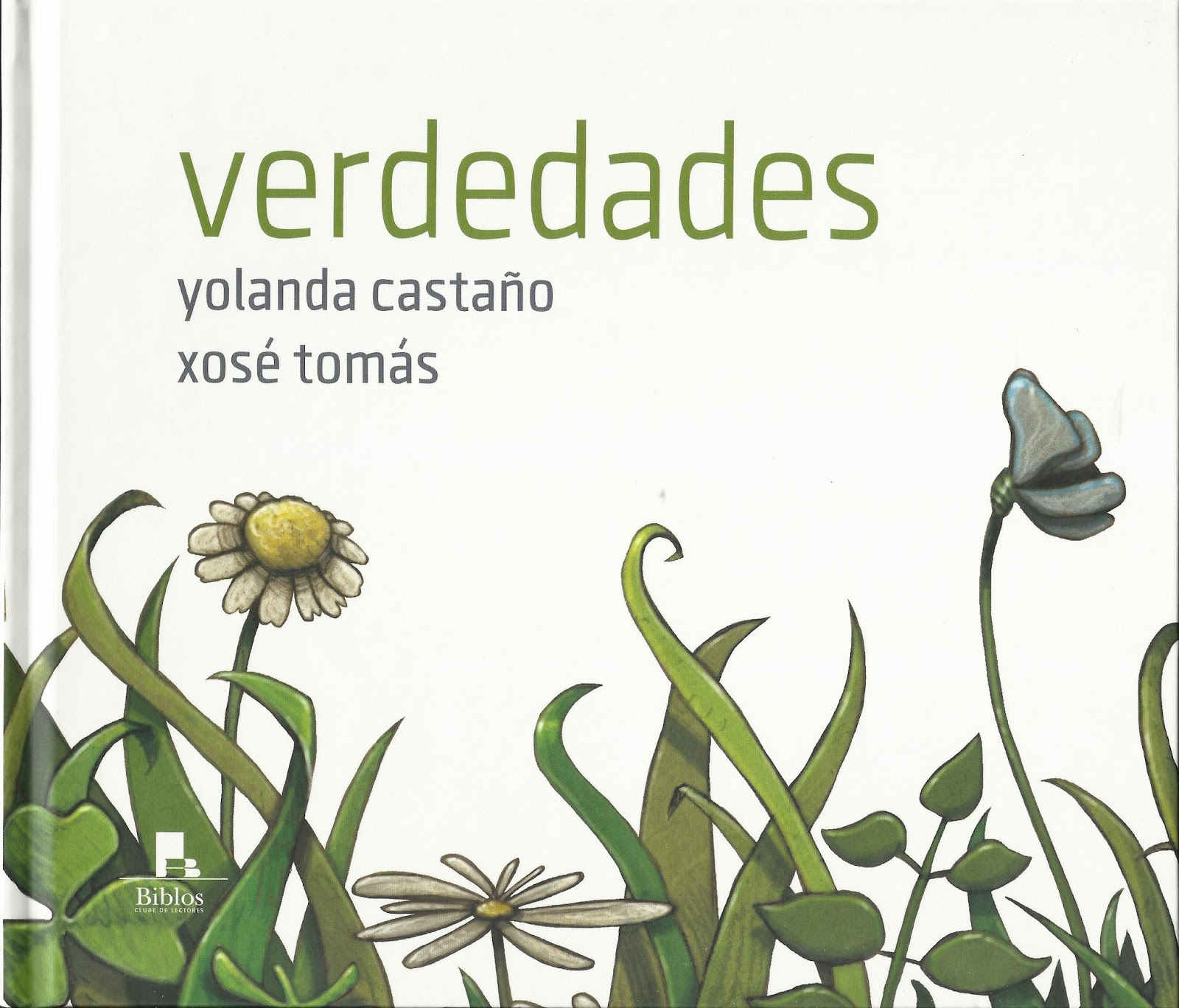
The story is about plants. Vegetal
elements, and poems arround them. The cover anticipates that topic showing
plants, herbs, leaving a white blank space inviting to enter this world.
It gives us the idea that not everything is done, and it is important
to enter the book to fill that gap. But, apart from the vegetal world,
the authors dedide to relate it with the human one, and then we can see
a family: a girl and her grandparents. On the back cover we may see this
human element. Both world melt, and plants acquire differente meanings,
because they accompany people in their lives. They are witnesses of their
relations, they heal diseases, and ever symbolize emotions.
O NENO QUE TIÑA
MEDO DOS ROBOTS / O ROBOT QUE TIÑA MEDO DOS NENOS
(Miguel Vázquez Freire / Xosé Tomás)
EDEBÉ-RODEIRA
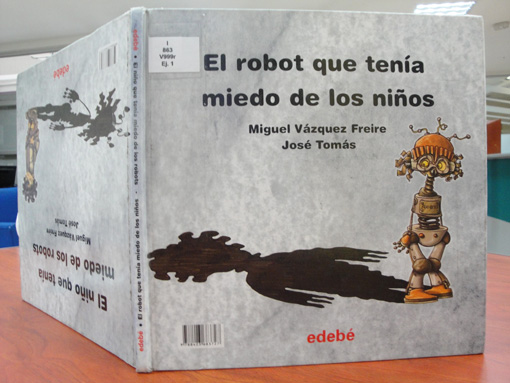
This a a book with a risky format:
two stories, two covers. It is the story of parallelyms: one boy is afraid
of robots, and one robot is afraid of children. Prejudices and fear to
different people. And the final encounter, of course in the middle of
the book. We can appreciate a game of contrasts in the illustrations of
both covers (we do not have a back cover here): the boy projects a shadow
of a robot, and vice versa. They a re both visual metaphors of their inner
fears. Both covers are inverted, so if we want to change from one story
to the other we must move the book upwards. As both stories share the
final illustrated scene, the image created for that double page is a view
from above, so that it can be read from any direction, from any perspective.
(Paco Martín / Xosé Tomás)
Editorial Galaxia
The cover is an invitation to enter. The character looks from outside a hole, and the reader is inside. The girl looks at us, and we do not know really where we are. It is a game of intrigue and curiosity, of suggesting that, behind that whole, there are fascinating stories, stimulateing the protagonist's curiosity.
VOU TER UN IRMÁN
(María Solar / Xosé Tomás)
Editorial Galaxia
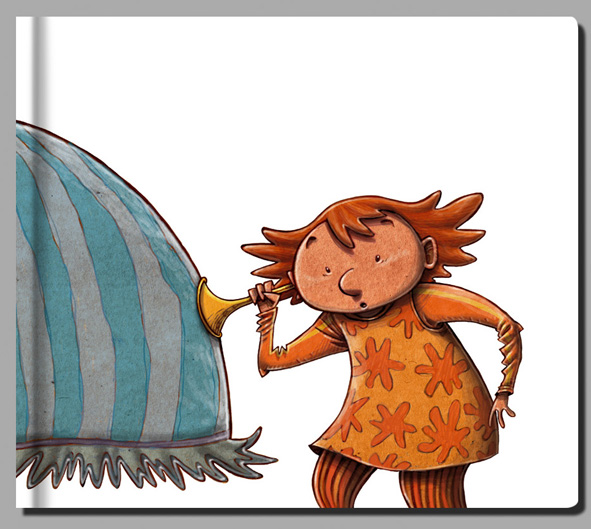
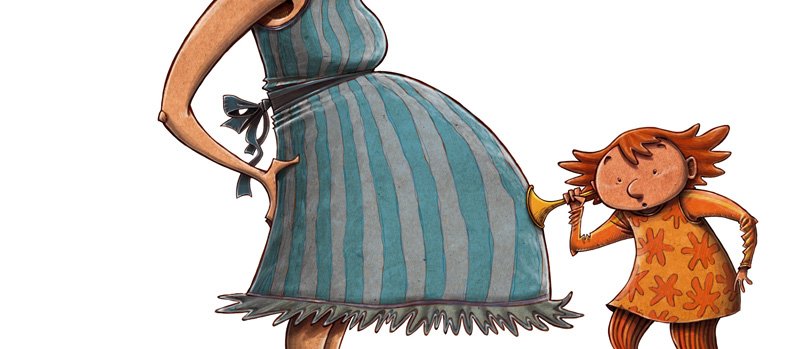
One girl is listening to what
seems to be a belly. But that belly is not complete on the cover. ACtually,
it does not fit it, because it is extended along the back cover. In order
to understant the image, it is essential to turn the book back. Then we
have the effect desired: to establish a "dialogue" between the
cover and the back cover, so that the reader gets involved into it. Both
covers form a unitary visual message.

ENDPAPERS
ENDPAPERS are complementary elements of the book, which we can see when opening the cover and back cover. They come before the book, and also after the book. The narrative possibilities of these elements are enormous:
- anticipate
- create an atmosphere
- extend one story
- others
Let us see some examples

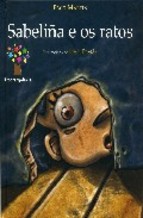
SABELIÑA E
OS RATOS
(Paco Martín / Xosé Tomás)
Editorial Galaxia
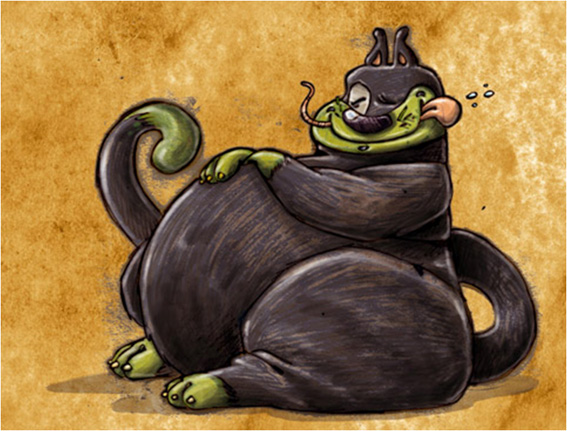
In Paco Martín's story mice bring presents to children when their teeth fall off. All execpt one evil mouse, who steals the presents for himself. This mouse appears on the first endpaper in an arrogant attitude. The illustrator, anfter talking to the writer, makes the decision to punish this mouse for such evil "crimes". And although in the written story te mouse gets rid of any punishment, in the final endpaper he suffers an "accident": the image shows the cat of the story who eats him up.
This is the proof that the illustrator's
role in a book may be much more than simple "illustrating" other
people's work and ideas. In this book, the story does not finish in the
ladt page of the text, but in the final endpaper. And it could happen
on the bak cover, too.
CANDO EU SAIBA LER
(Yolanda Castaño / Xosé Tomás)
Editorial Galaxia
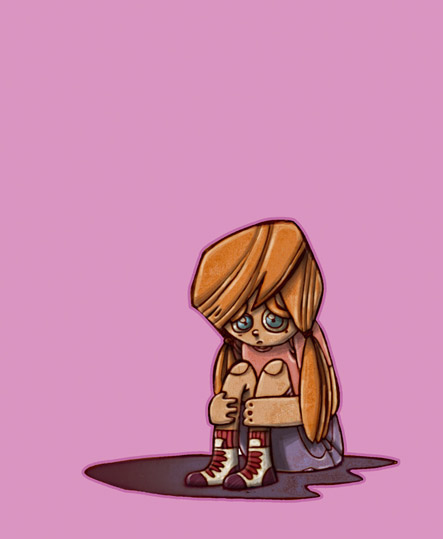
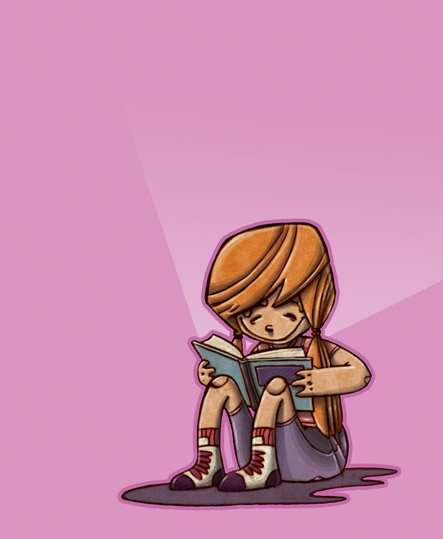
The aim of this book is to teach vowel and vowel sounds to the smaller ones, in the Galician language. Through poems and allusive images, they learn the graphemes and also the sounds. At the end of the boook they have experienced a long was of discovery and learning. For that reason, the first endpaper shows one little girl with a book. She is sad, because she cannot yet read. On the second endpaper, as she already knows how to read, she has a happy look on her face. There is, so, a dialogue between both endpapers.

EL GRAN LIBRO DE RELATOS
DE PIRATAS Y CORSARIOS
(Joan e Albert Vinyoli / Xosé Tomás)
Editorial Parramón
The topic of the book
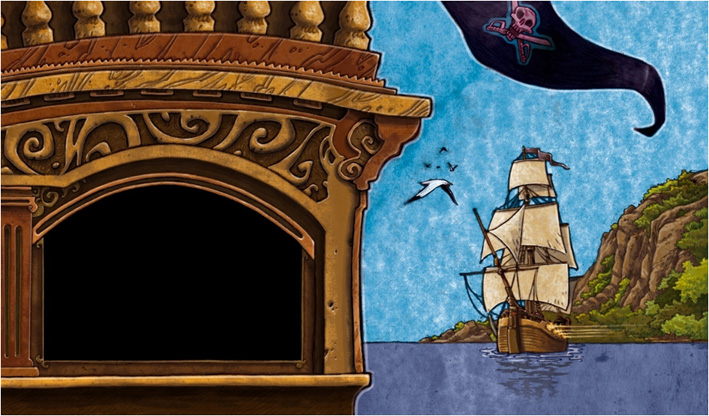
is pirates, corsaries, ships, battles in the sea. The cover has a special
physical characteristic: a hole. The illustrator takes advantage of this
circumstance to transform it into a narrative tools, and he transforms
it into a window. The cover shows the inside of a ship cabin. We are iiside
a ship. When we open the cover, we "open the window", and we
are already outside. On the endpaper we can see the same window, but from
outside the ship, and we can also see how another ship is coming to us,
shooting at us. We also discover we have a black flag: we are pirates!
In this case, the dialogue game is established between the cover and the
back cover.
Na segunda garda temos un diálogo co libro completo, coas historias
das "tripas".
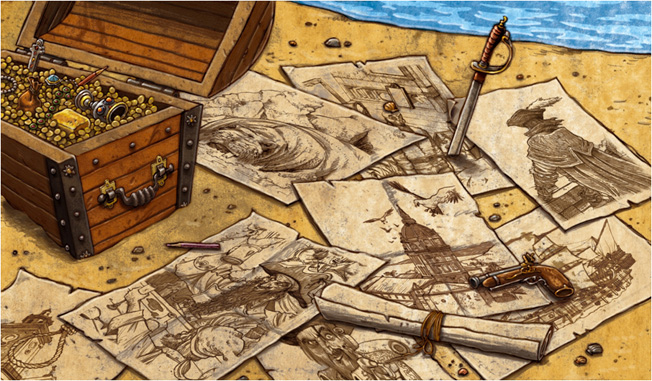
On the second endpaper
we have a dialogue with the whole book, with the stories told inside.
it is a double-page image with a desert beach, a treasure, and what seems
to be the remains of a wreckage: papers, pencils, chests with coins, swords,
guns, ... It is the illustrator's wreckage, after the hard work of creating
the images for the whole book. But it is not only that. Those images made
in pencil spread out on the sand are the sketches that finally became
the definitive illustrations of the book. This way the reader may play
the game of comparing them with the final arts. And, therefore, he may
read back the book again.
O SOUTO ESCURO E PERIGOSO
(Miguel Vázquez Freire / Xosé Tomás)
Edicións Xerais de Galicia
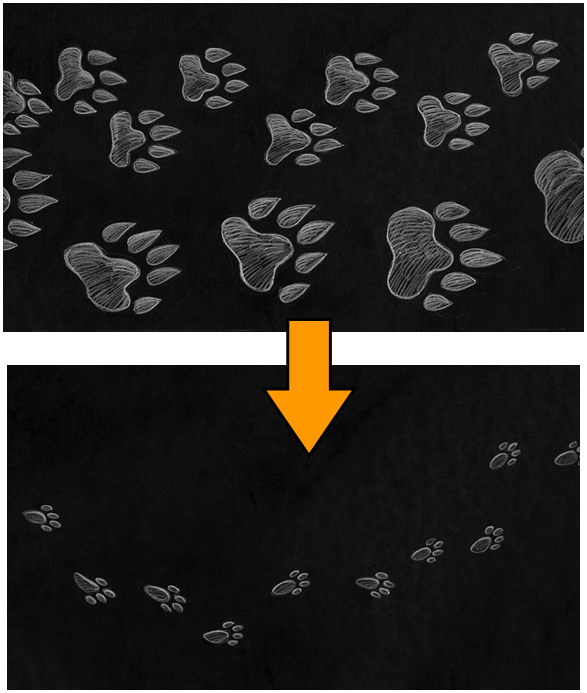
This is a horror story. A tender small rabbit is chased by two terrible beasts: one bear and one wolf. on the first endpaper we can see the predators' footprints, moving rightwards, after their prey. On the second endpaper we can only see some little footprints. The rabbit's footprints. Both endpapers convey information to the reader about how the story ends, even without reading it through: the rabbit is finally victorious, and we see it on the final footprints.

FLIS-FLI-RIS-FLAS
(Araceli Gonda / Xosé Tomás)
Editorial Galaxia
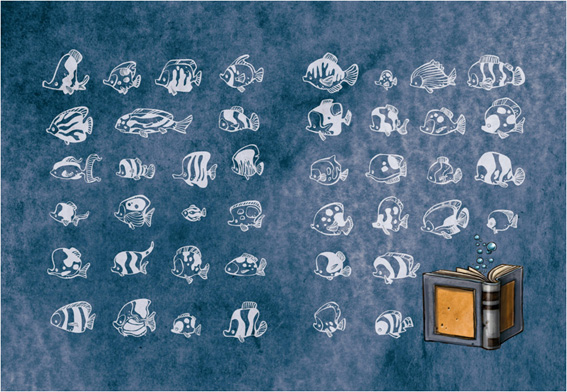
This book mixes up the topic of reading
and the sea. Books and fish, the idea of diving into reading and penetrating
into fascinating, oniric worlds. Then, the first endpaper is a mosaic
of many fish and one book. And the second one has got a mosaic of many
books and one fish. This transmits the idea that in this story reading
is so important as the sea.
OS AMIGOS DE SANTI
(Araceli Gonda / Xosé Tomás)
Editorial Galaxia
Santi is a boy who is looking for
friends. He tries once and again, and he does not always succeeds. Then
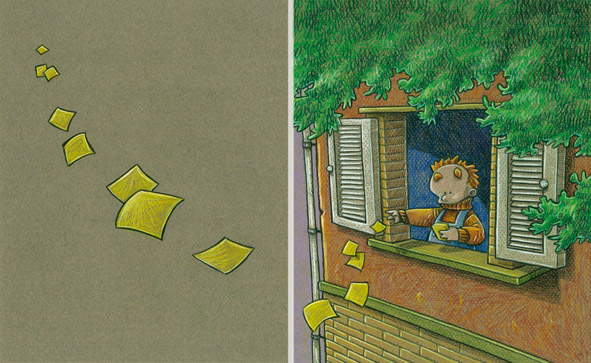
the story is over. the cover is designed by the ilustrator adding one
element which does not appear
in the text of the book: Santi, looking out of the window, is throwing
yellow stickers to the street. We cannot see the content of these messages.
We open the cover, and on the first endpaper we satisfy our curiosity,
because we can see the words from the notes: "a friend is offered
to play", "if you want to walk on the park, call me", and
others. This endpaper shows elements to characterize the protagonist,
complementing this way the story inside. Santi becomes a boy looking for
company, and he even does it by throwing notes to the street.